Suomi
 Svenska
 Polski
 Čeština
 Slovenčina
 Norsk
 Dansk
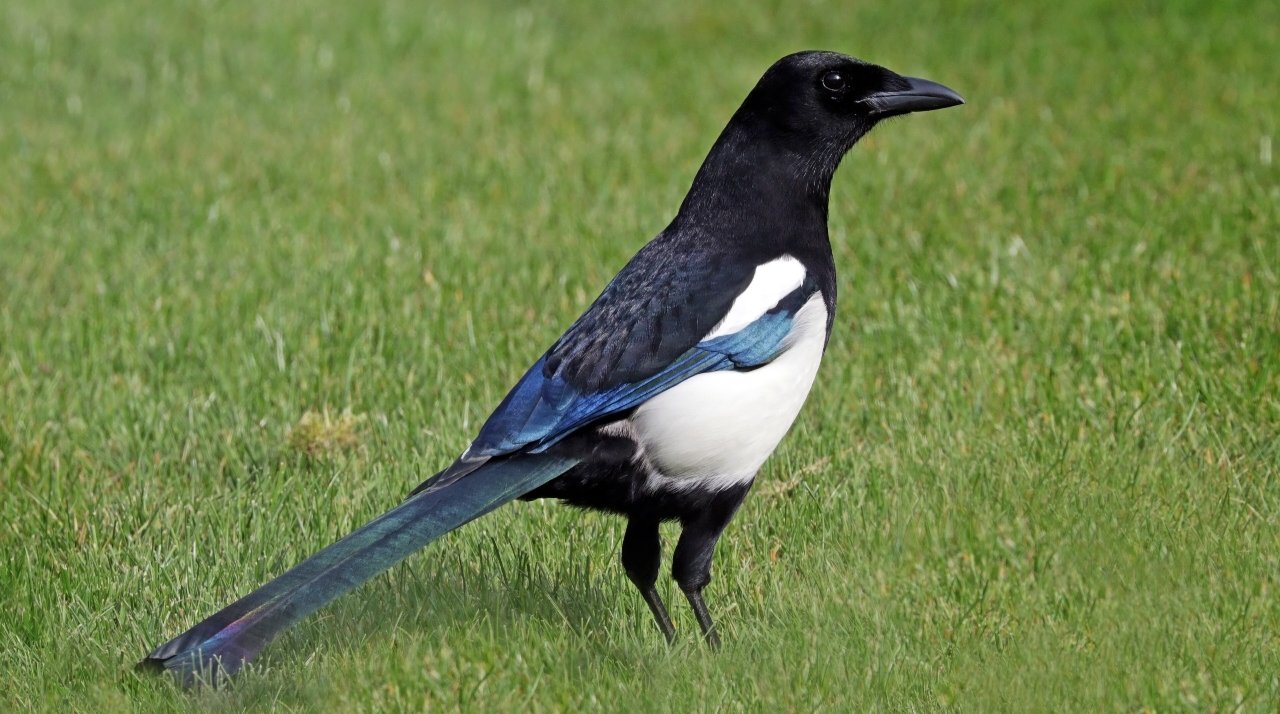
Eurasian Magpie
Pica pica
Identify the Eurasian Magpie by sound or photo and log your sightings with Birdpass.


The Eurasian Magpie is a striking black-and-white crow with a very long, iridescent tail, found across much of temperate Eurasia. Common in open countryside and towns, it has adapted well to living near people. Renowned for its intelligence, it is one of the few birds shown to recognise itself in a mirror. Despite the similar name and colours, it is not related to the Australian Magpie.
Did you know?
- It is one of the few birds to pass the mirror self-recognition test.
- Its domed nest has a roof of thorny twigs and a side entrance.
Voice
About the species
Identification
A long-tailed, clearly black-and-white crow: glossy black head, back and breast, a white belly and large white shoulder patches; the tail is very long with a green sheen, and the wings have a blue-green gloss with white primaries in flight. The call is a harsh, rattling chatter.
Family
Corvidae
Size
Medium (thrush)
Colours
black, white, blue, green
About the habitat
Open and semi-open landscapes with scattered trees – farmland, hedgerows, villages, towns, parks and gardens; it avoids dense, continuous forest and treeless expanses.
Diet
Omnivorous: insects and other invertebrates, small vertebrates, carrion, eggs and nestlings, as well as seeds, grain, berries, fruit and food scraps.
Behaviour
Bold and noisy, it gives a harsh, chattering rattle and often mobs birds of prey. It forages mainly on the ground, walking and probing, and caches food. Pairs are monogamous and territorial and build a large, domed nest of sticks, often thorny, with a side entrance high in a tree or tall shrub. Outside the breeding season magpies gather at communal roosts.
Sources
Photo: Charlesjsharp, CC BY-SA 4.0
Sound: Sonothèque ADVL, XC776701, CC0 1.0 https://xeno-canto.org/776701
Sound: Benoît Van Hecke, XC1073944, CC BY-SA 4.0 https://xeno-canto.org/1073944
Text: Wikipedia (English) + GBIF regional observations + Wikipedia (Danish) + FinBIF species descriptions, CC BY-SA 4.0; GBIF occurrence data; Wikipedia: CC BY-SA 4.0; FinBIF: CC BY 4.0 https://en.wikipedia.org/wiki/Eurasian_magpie