Suomi
 Svenska
 Polski
 Čeština
 Slovenčina
 Norsk
 Dansk
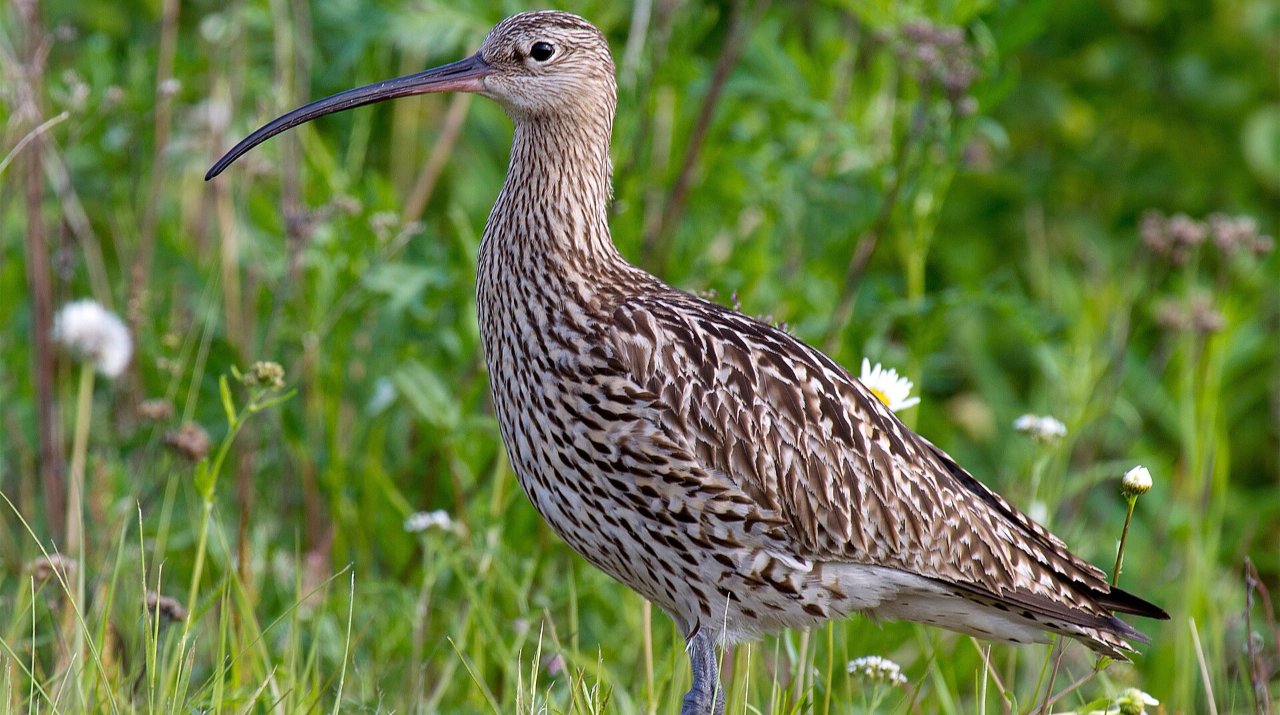
Eurasian Curlew
Numenius arquata
Identify the Eurasian Curlew by sound or photo and log your sightings with Birdpass.


The Eurasian Curlew is Europe's largest wader, instantly recognised by its very long, downcurved bill and haunting, bubbling “cur-lee” call. It breeds in open, wet landscapes across temperate Europe and Asia and winters on coasts and estuaries from western Europe to Africa and southern Asia. Once widespread and common, it has declined in many areas and is listed as Near Threatened.
Did you know?
- Its name imitates its bubbling call.
- Curlews sometimes nest near Kestrels, gaining protection from crows.
Voice
About the species
Identification
A very large wader with a long, downcurved bill (on average longer in females). The overall colour is grey-brown and streaked; in flight a white wedge up the back and dark outer wings show. It is told from Whimbrel by its larger size, clearly longer bill and lack of bold head stripes.
Family
Scolopacidae
Size
Large (crow)
Colours
brown, white, grey
About the habitat
Breeds on bogs, wet meadows, moorland, rough grassland and farmland; outside the breeding season tidal flats, estuaries, salt marshes and wet pastures.
Diet
Mainly worms, insect larvae, small crustaceans and molluscs probed from soft mud, sand or damp soil; also earthworms on pasture, small crabs and occasionally berries.
Behaviour
Feeds methodically by walking and deep probing. Wary and highly gregarious outside the breeding season, it forms flocks on coasts and roosts at high tide. It nests in a simple ground scrape, laying four eggs, and both adults incubate. Its bubbling display song is delivered in a gliding song flight.
Sources
Photo: Andreas Trepte, CC BY-SA 2.5 https://commons.wikimedia.org/wiki/File:Eurasian Curlew.jpg
Sound: wilmet sebastien, XC987706, CC0 1.0 https://xeno-canto.org/987706
Sound: Sonothèque ADVL, XC707061, CC0 1.0 https://xeno-canto.org/707061
Sound: Sonothèque ADVL, XC918540, CC0 1.0 https://xeno-canto.org/918540
Sound: Beeld en Geluid, CC BY-SA 3.0 https://commons.wikimedia.org/wiki/File:Alarmroep_van_een_wulp_en_kreten_van_een_jong_-_SoundCloud_-_Beeld_en_Geluid.ogg
Text: Wikipedia (English) + FinBIF species descriptions, CC BY-SA 4.0; FinBIF: CC BY 4.0 https://en.wikipedia.org/wiki/Eurasian_curlew