
 Suomi
 Svenska
 Polski
 Čeština
 Slovenčina
 Norsk
 Dansk
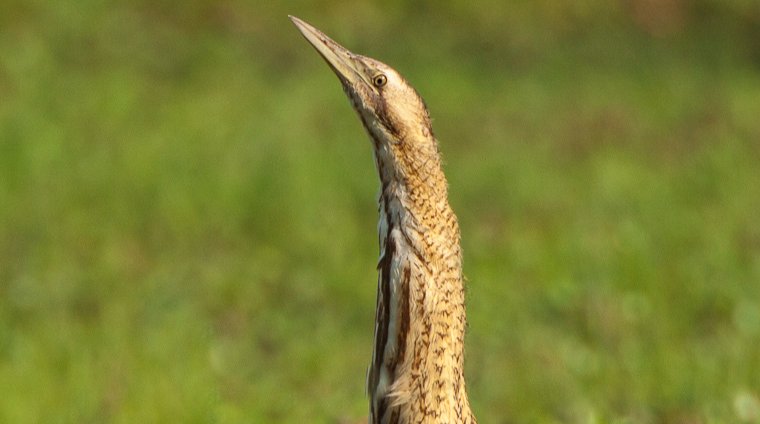
Eurasian Bittern
Botaurus stellaris
Identify the Eurasian Bittern by sound or photo and log your sightings with Birdpass.


The Eurasian Bittern is a large, thickset, cryptically coloured heron of extensive reedbeds and marshes across the Palearctic, with a separate subspecies in southern Africa. Secretive and rarely seen, it is most often detected by the male's deep, far-carrying boom in spring. Although assessed globally as Least Concern, wetland loss has caused declines, and some local populations, especially in western Europe and southern Africa, are of special concern.
Did you know?
- Its booming call gave rise to folk names such as “bog-bull”.
- It is the largest of the bitterns.
Voice
About the species
Identification
A large, brown, heavily streaked and barred heron whose plumage blends with the reeds. It usually stays hidden and freezes upright in the reedbed; the male's deep booming call is very characteristic. In flight it is heavy and round-winged, told from other herons by its dark brown, streaked plumage and strong association with reedbeds.
Family
Ardeidae
Size
Very large (swan)
Colours
brown, black, orange, white
About the habitat
Extensive reedbeds and rank waterside vegetation around lakes, sheltered coastal bays and sluggish rivers; outside the breeding season also fish ponds, ditches and flooded areas.
Diet
An opportunistic predator of fish, especially eels, and frogs, as well as small mammals, fledgling birds, crustaceans and insects, taken by stealth along reed margins and in shallow water.
Behaviour
A shy skulker of dense reedbeds that relies on camouflage; when alarmed it stands bolt upright with the bill pointing up, even swaying with the reeds. The male's boom can carry several kilometres. Males are often polygynous; the female alone builds the nest among reeds at the water's edge, incubates and feeds the young, which leave the nest at about two weeks. Northern populations migrate, others are resident.
Sources
Photo: Francesco Veronesi from Italy, CC BY-SA 2.0 https://commons.wikimedia.org/wiki/File:Eurasian Bittern - Torrile - Italy 4528 (15409347121).jpg
Sound: Miro Demko, XC362697, CC BY-SA 4.0 https://xeno-canto.org/362697
Sound: Joost van Bruggen, XC434683, CC BY-SA 4.0 https://xeno-canto.org/434683
Text: Wikipedia (English) + FinBIF species descriptions + Wikipedia (Finnish), CC BY-SA 4.0; FinBIF: CC BY 4.0; Wikipedia: CC BY-SA 4.0 https://en.wikipedia.org/wiki/Eurasian_bittern
.jpg)