
 Suomi
 Svenska
 Polski
 Čeština
 Slovenčina
 Norsk
 Dansk
Dunnock
Prunella modularis
Identify the Dunnock by sound or photo and log your sightings with Birdpass.


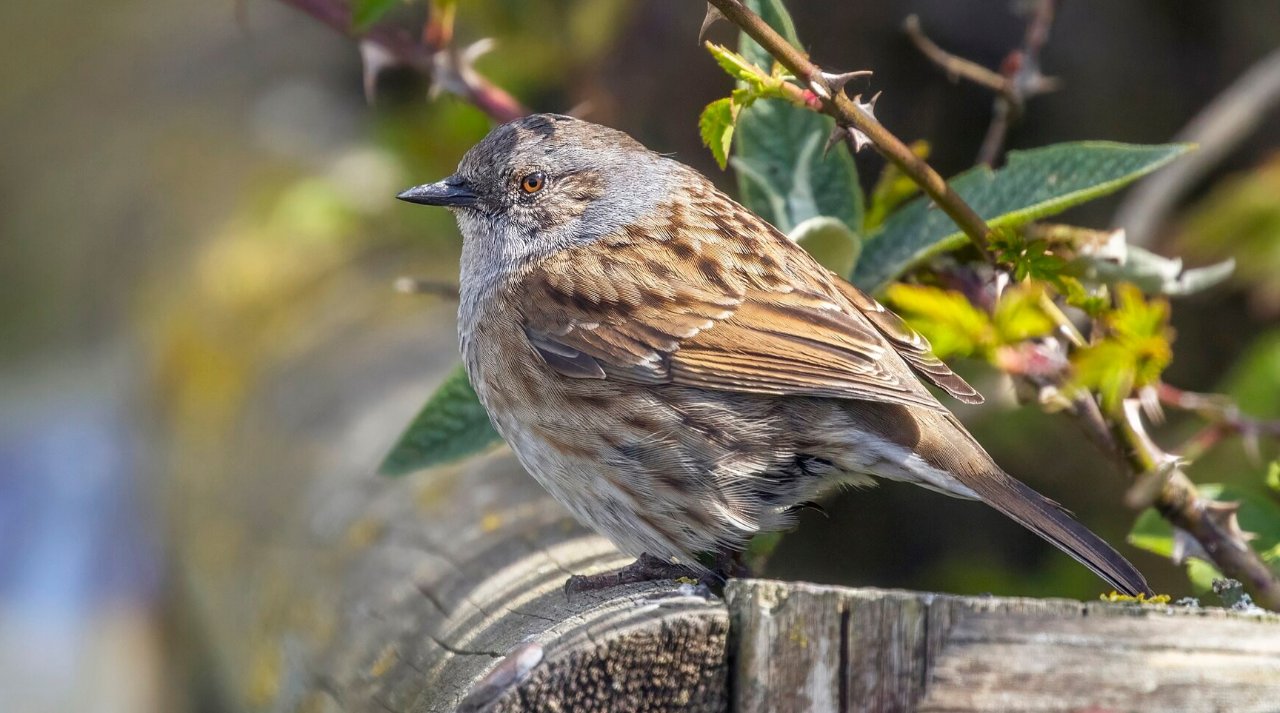
The Dunnock is a small, shy accentor of hedges, undergrowth and dense conifer thickets, widespread across Europe into western Asia and introduced to New Zealand. Brown and streaked with a lead-grey head and breast and a fine bill, it slips unnoticed through shrubs. It is the most widespread accentor and has a famously complex mating system.
Did you know?
- Despite its old name “hedge sparrow”, it is not a sparrow but an accentor.
- It has one of the most unusual mating systems of any small bird.
Voice
About the species
Identification
A smallish, brownish songbird with a lead-grey head and breast and a dark-streaked back. Its thin, straight insect-eater's bill separates it from the thick-billed sparrows. The sexes look alike. Its clear, tinkling song, often sung from treetops, helps identification; the call is a thin, high “tseep”.
Family
Prunellidae
Size
Small (sparrow)
Colours
grey, brown, black, white
About the habitat
Dense, low vegetation – young spruce forest, hedgerows, garden shrubs, thickets and scrubby woodland edges.
Diet
Mainly small invertebrates – insects, spiders and larvae – picked from leaf litter and low vegetation; in winter also small seeds.
Behaviour
Keeps low and close to cover, shuffling like a mouse and flicking its wings. In spring it sings a thin, rapid, tinkling warble from a treetop. Its mating system ranges from monogamy to polyandry and polygynandry, with several males sharing care at one nest. It nests low in dense shrubs or young spruces and lays sky-blue eggs.
Sources
Photo: Charles J. Sharp, CC BY-SA 4.0 https://commons.wikimedia.org/wiki/File:Dunnock (Prunella modularis) 3.jpg
Sound: Tim Vochten, XC798315, CC BY-SA 4.0 https://xeno-canto.org/798315
Sound: Sonothèque ADVL, XC730618, CC0 1.0 https://xeno-canto.org/730618
Sound: Sonothèque ADVL, XC707284, CC0 1.0 https://xeno-canto.org/707284
Text: Wikipedia (English) + FinBIF species descriptions, CC BY-SA 4.0; FinBIF: CC BY 4.0 https://en.wikipedia.org/wiki/Dunnock
 3.jpg)