
 Suomi
 Svenska
 Polski
 Čeština
 Slovenčina
 Norsk
 Dansk
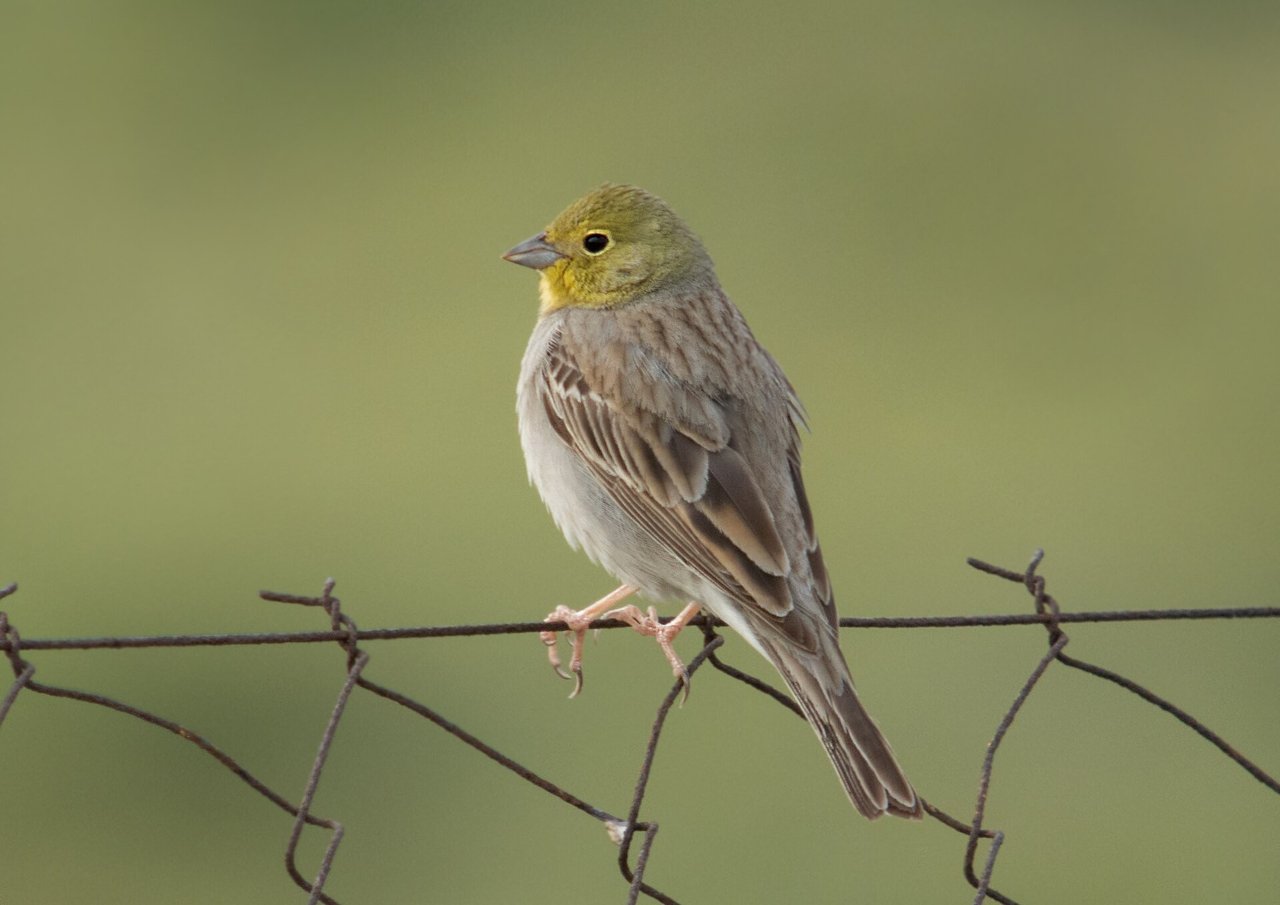
Cinereous Bunting
Emberiza cineracea
Identify the Cinereous Bunting by sound or photo and log your sightings with Birdpass.


The Cinereous Bunting is a slim, long-tailed bunting of dry, rocky landscapes in south-western Asia, with small outposts on Greek Aegean islands. Males have a dull yellow head and either grey or yellow underparts, depending on the form. It breeds in Turkey and Iran and winters around the Red Sea in north-east Africa and Yemen. It is listed as Near Threatened, with habitat loss thought to be driving declines.
Did you know?
- “Cinereous” means ash-grey, a nod to its subdued plumage.
- The two forms differ: the nominate form has grey underparts, while the eastern form (E. c. semenowi) is yellow below.
About the species
Identification
A rather plain, greyish bunting with a long tail showing white outer feathers. The male has a dull yellowish head and throat with a yellowish eye-ring; the underparts are grey in the western form and yellowish in the eastern one. Females and young are browner and faintly streaked, with a pale throat. The bill is greyish.
Family
Emberizidae
Size
Small (sparrow)
Colours
yellow, brown, grey, white
About the habitat
Breeds on dry, rocky slopes and uplands with shrubs, sometimes among scattered pines or taller bushes. On migration it uses semi-deserts, low rocky hills and barren farmland, and it winters in coastal areas with sparse scrub.
Diet
Mainly seeds, with insects especially when feeding young.
Behaviour
A migratory bunting with a harsh call and a hoarse, repeated “zru-zru” song, often sung from exposed perches. The usual clutch is three eggs.
Sources
Photo: Frank Vassen from Brussels, Belgium, CC BY 2.0 https://commons.wikimedia.org/wiki/File:Cinereous Bunting (Emberiza cineracea), Lesvos, Greece, 17.04.2015 (17284201896) (cropped).jpg
Text: Wikipedia (English), CC BY-SA 4.0 https://en.wikipedia.org/wiki/Cinereous_bunting
, Lesvos, Greece, 17.04.2015 (17284201896) (cropped).jpg)