
 Suomi
 Svenska
 Polski
 Čeština
 Slovenčina
 Norsk
 Dansk
Rock Bunting
Emberiza cia
Identify the Rock Bunting by sound or photo and log your sightings with Birdpass.


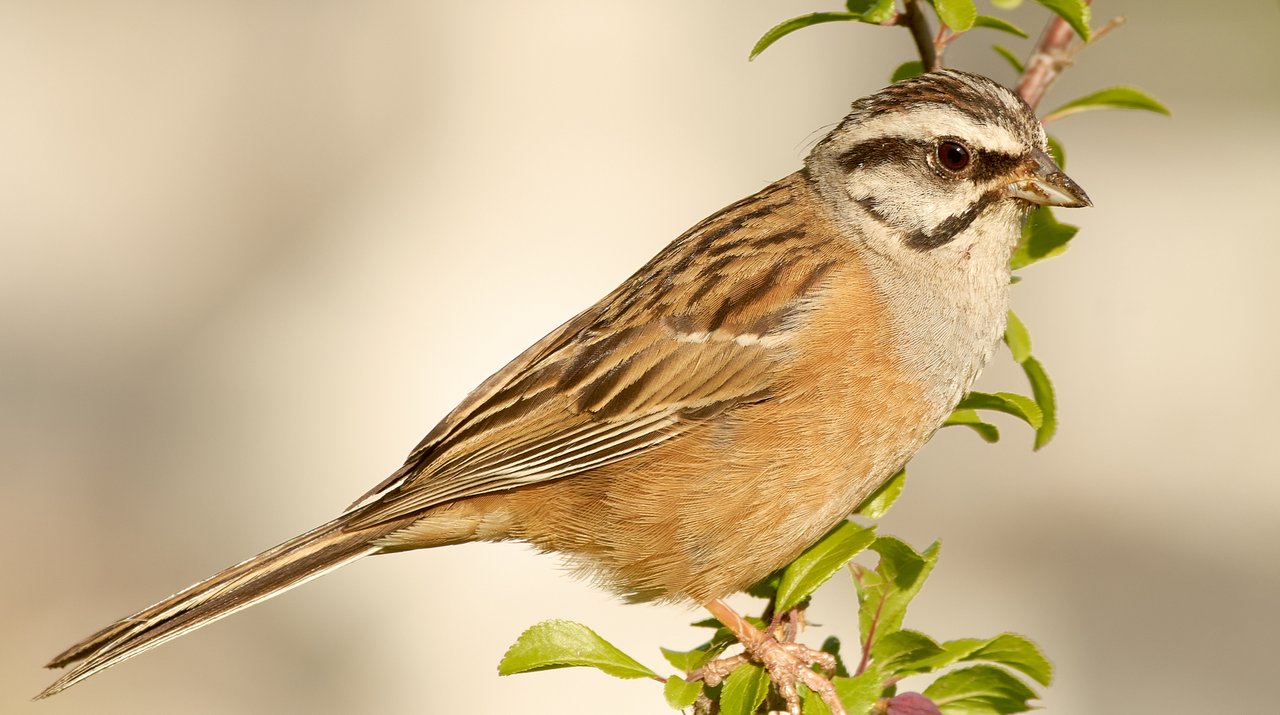
The Rock Bunting is a mountain-loving bunting of open, dry, rocky country across parts of northwest Africa, southern Europe, central Asia, and the Himalayas. Males show a striking grey head with bold black striping, warm chestnut upperparts, and unmarked buff underparts, while females and juveniles are duller. It is partially migratory, with some populations moving to milder areas outside the breeding season. Its sharp, sibilant call and twittering song often carry across stony slopes and crags.
Did you know?
- Its scientific name reflects sound: the specific name cia comes from an Italian word linked to zirlare, meaning “to chirp.”
- Several subspecies vary mainly in plumage tone; some show neat white wing bars.
Voice
About the species
Identification
A medium-sized bunting with a distinctive pale grey head crisply patterned with black crown, eye, and moustachial stripes; warm chestnut upperparts; and plain, deep buff underparts lacking streaks. Females are paler and browner with a less contrasting head, and juveniles resemble females but show a streaked head. Some birds show fine white wing bars. The combination of a boldly striped grey head, unmarked buff underparts, and chestnut back in rocky habitats helps separate it from other buntings.
Family
Emberizidae
Size
Small (sparrow)
Colours
grey, orange, black, brown, white
About the habitat
Open, dry, rocky slopes and mountainous terrain, typically with sparse vegetation, scattered stones, and occasional low bushes or crags.
Diet
Feeds largely on seeds outside the breeding season; switches to insects and other small invertebrates when raising young.
Behaviour
Forages mainly on the ground and low vegetation, picking seeds and invertebrates among rocks and sparse scrub. Nests are placed on the ground or occasionally in a low bush, and adults deliver insect prey to nestlings. Males often sing from exposed rocks or shrubs. The species is partially migratory, with some birds moving south or downslope in winter.
Sources
Photo: Hobbyfotowiki, CC0 https://commons.wikimedia.org/wiki/File:Rock Bunting (Cochem).jpg
Sound: Benoît Van Hecke, CC BY-SA 4.0 https://commons.wikimedia.org/wiki/File:Emberiza_cia_-_Rock_Bunting_XC576668.mp3
Text: Wikipedia (English), CC BY-SA 4.0 https://en.wikipedia.org/wiki/Rock_bunting
.jpg)