Suomi
 Svenska
 Polski
 Čeština
 Slovenčina
 Norsk
 Dansk
Black-tailed Godwit
Limosa limosa
Identify the Black-tailed Godwit by sound or photo and log your sightings with Birdpass.


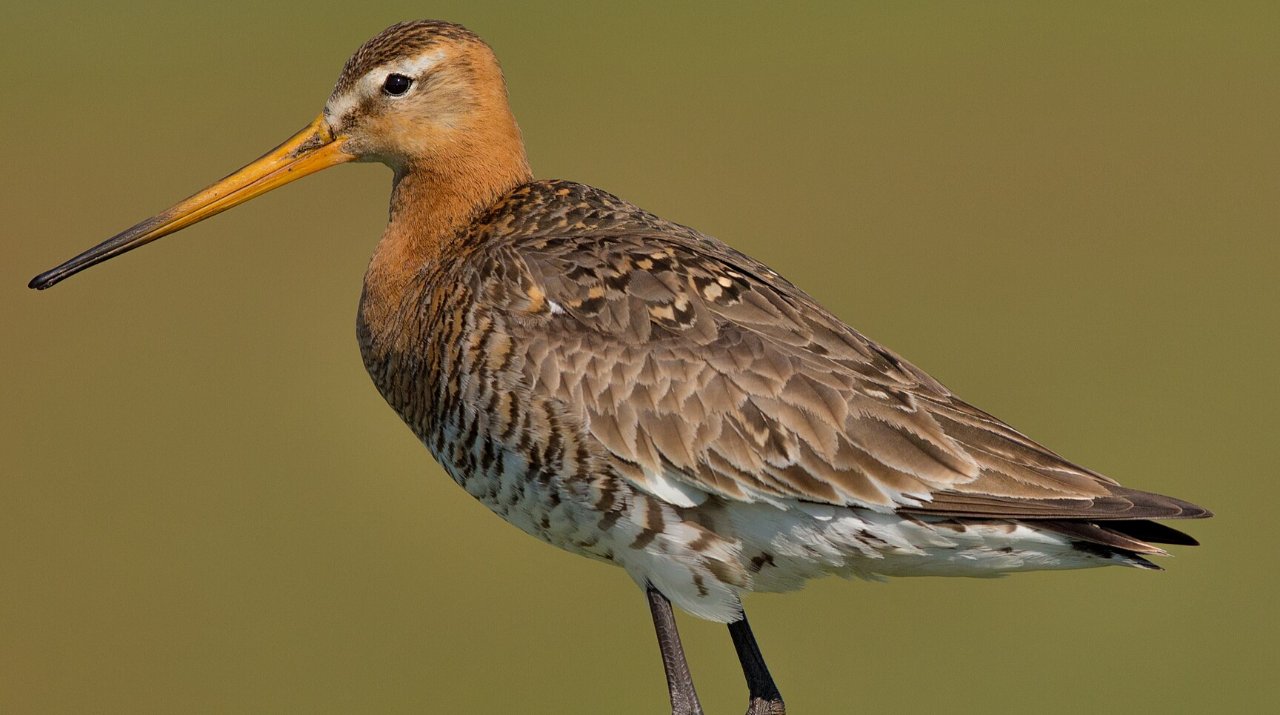
The Black-tailed Godwit is a tall, elegant wader with long legs and a long, straight bill, flashing bold white wing bars, a white rump and a black tail in flight. It breeds from Iceland across Europe to Central Asia and winters from western Europe and Africa to South and Southeast Asia and Australia, using inland freshwater sites more than the Bar-tailed Godwit. In breeding plumage it has rich orange on the head, neck and breast. It is Near Threatened globally.
Did you know?
- The name “godwit” is thought to imitate its call.
- It is the national bird of the Netherlands.
Voice
About the species
Identification
A long-legged, long-billed wader. In breeding plumage the breast, neck and nape are bright rufous, the belly pale with dark bars and the back mottled grey and brown; in winter it is plain grey, and young birds have a buff breast and neck. In all plumages the broad white wing bars, white rump and black-tipped tail are diagnostic; the bill is straight and pinkish at the base. Its display flight has a distinctive yodelling call.
Family
Scolopacidae
Size
Large (crow)
Colours
brown, orange, grey, black, white
About the habitat
Breeds on wet meadows, fens, bog edges and marshy grasslands with shallow water; outside the breeding season estuaries, mudflats, flooded fields, rice paddies and inland wetlands.
Diet
Mainly invertebrates – worms, insect larvae, molluscs and small crustaceans – probed from soft soil and mud; also seeds and plant material outside the breeding season, including rice.
Behaviour
A long-distance migrant that travels and feeds in flocks and roosts communally. Mostly monogamous, it nests in loose colonies on wet meadows; males perform display flights with loud, ringing calls. Both parents incubate the ground nest, and the downy chicks leave soon after hatching and fledge in about 25–30 days.
Sources
Photo: Andreas Trepte, CC BY-SA 2.5 https://commons.wikimedia.org/wiki/File:Black-tailed Godwit Uferschnepfe.jpg
Sound: Pascal Christe, XC466468, CC BY-SA 4.0 https://xeno-canto.org/466468
Sound: Sharadapte, CC BY-SA 4.0 https://commons.wikimedia.org/wiki/File:Black-tailed_godwit_call_recorded_in_March_2005_at_Mayani_Sanctuary,_Satara.wav
Text: Wikipedia (English) + FinBIF species descriptions, CC BY-SA 4.0; FinBIF: CC BY 4.0 https://en.wikipedia.org/wiki/Black-tailed_godwit