Suomi
 Svenska
 Polski
 Čeština
 Slovenčina
 Norsk
 Dansk
Black Scoter
Melanitta americana
Identify the Black Scoter by sound or photo and log your sightings with Birdpass.


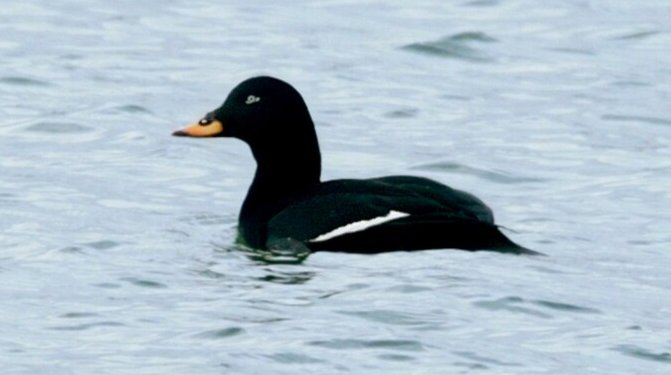
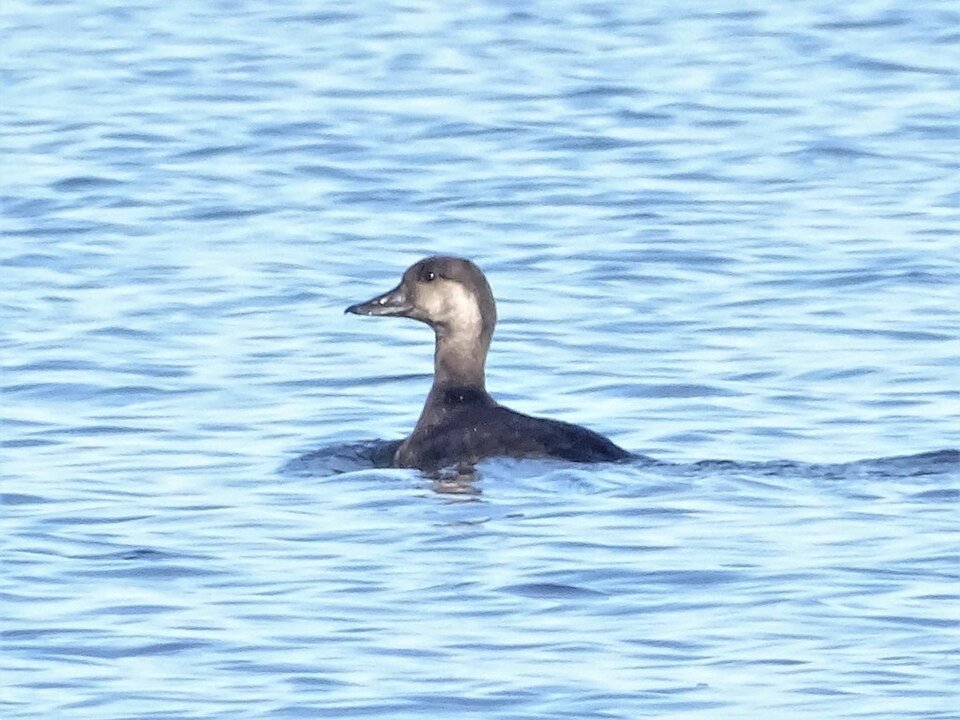
The Black Scoter is a bulky sea duck of North America and north-eastern Siberia. Males are entirely black with a swollen, mostly yellow-orange knob on the bill, while females are brown with pale cheeks. It breeds in the far north and winters on temperate coasts of North America and East Asia, gathering in tight flocks offshore. Once lumped with the Common Scoter, it differs in bill shape and voice. It is listed as Near Threatened.
Did you know?
- When a male stretches its wings, it often makes a distinctive downward head movement.
- Winter flocks are so tightly packed that they often take off in unison.
About the species
Identification
The male is an all-black sea duck with a large, bulging orange-yellow knob covering the base of the bill, giving the head a steep profile. The female is dark brown with paler cheeks. It resembles Common Scoter, but the male's much more swollen, orange-yellow bill helps separate it.
Family
Anatidae
Size
Large (crow)
Colours
black, yellow
About the habitat
Breeds by lakes, rivers and pools in northern woodland and tundra; winters on temperate coastal seas, often in sheltered bays.
Diet
At sea mainly molluscs and crustaceans taken by diving; on breeding lakes aquatic insects such as caddisflies, fish eggs and some plant matter.
Behaviour
A strong diver that forms large, compact flocks in winter, often taking off together. Pairs form in late winter or spring and nest on the ground near water; the female incubates, and the young become independent at about three weeks, before they can fly. Males give far-carrying, mournful whistles.
Sources
Photo: Natthager, CC BY-SA 4.0 https://commons.wikimedia.org/wiki/File:BlackScoter mosbo6.jpg
Text: Wikipedia (English), CC BY-SA 4.0 https://en.wikipedia.org/wiki/Black_scoter