Suomi
 Svenska
 Polski
 Čeština
 Slovenčina
 Norsk
 Dansk
Wilson's Snipe
Gallinago delicata
Identify the Wilson's Snipe by sound or photo and log your sightings with Birdpass.


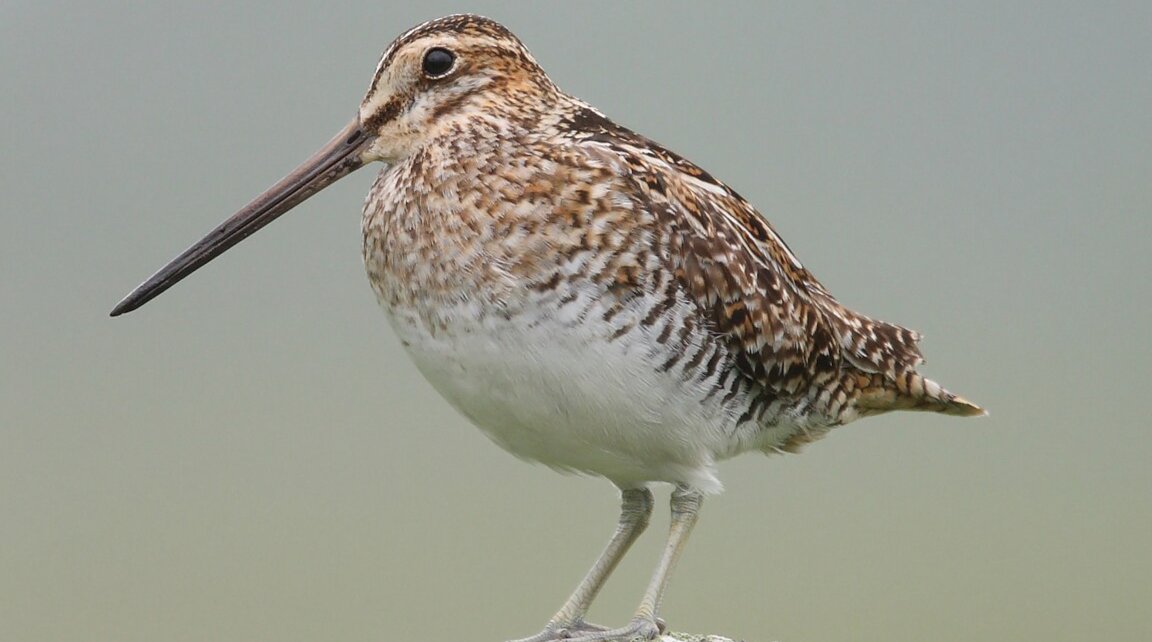
Wilson's Snipe is a small, stocky wader of marshes, bogs, tundra and wet meadows across much of North America. Long treated as part of the Common Snipe, it is now recognised as a separate species, named after the ornithologist Alexander Wilson. Its mottled brown plumage hides it in wetland vegetation, and its very long, straight bill is built for probing soft ground. It is a rare vagrant to Europe and very hard to tell from Common Snipe.
Did you know?
- The eerie “winnowing” sound is made by air rushing over the outspread outer tail feathers, not by the voice.
- It has eight pairs of tail feathers, whereas the Common Snipe has seven.
Voice
About the species
Identification
A smallish, mottled brown snipe with a very long, straight bill, pale stripes on the back and a striped head. The belly is pale and the flanks densely barred. The white trailing edge of the wing is narrower than in Common Snipe, and it has eight rather than seven pairs of tail feathers. Separation from Common Snipe is difficult; the best clues are voice and the sound of the display flight, together with photographs.
Family
Scolopacidae
Size
Medium (thrush)
Colours
brown, black, white, orange
About the habitat
Wet habitats with soft ground and shallow water – sedge marshes, wet meadows, fens, bogs and tundra; breeds across Canada and the northern United States and winters south to northern South America.
Diet
Mainly insect larvae and adults, earthworms and other invertebrates probed from soft mud and wet soil; occasionally seeds.
Behaviour
Shy and well camouflaged, it often crouches motionless until approached closely, then flushes and zigzags away at speed. Males perform long display flights, diving to produce a “winnowing” sound with the outer tail feathers, by day and into the night. It nests on the ground, well hidden in dense vegetation.
Sources
Photo: Gallinago-delicata-002.jpg: Mdfderivative work: Donkey shot, CC BY-SA 3.0 https://commons.wikimedia.org/wiki/File:Gallinago-delicata-002-cropped.jpg
Sound: Doug Hynes, XC609619, CC BY-SA 4.0 https://xeno-canto.org/609619
Text: Wikipedia (English) + GBIF regional observations + Wikipedia (Finnish), CC BY-SA 4.0; GBIF occurrence data; Wikipedia: CC BY-SA 4.0 https://en.wikipedia.org/wiki/Wilson%27s_snipe