
 Suomi
 Svenska
 Polski
 Čeština
 Slovenčina
 Norsk
 Dansk
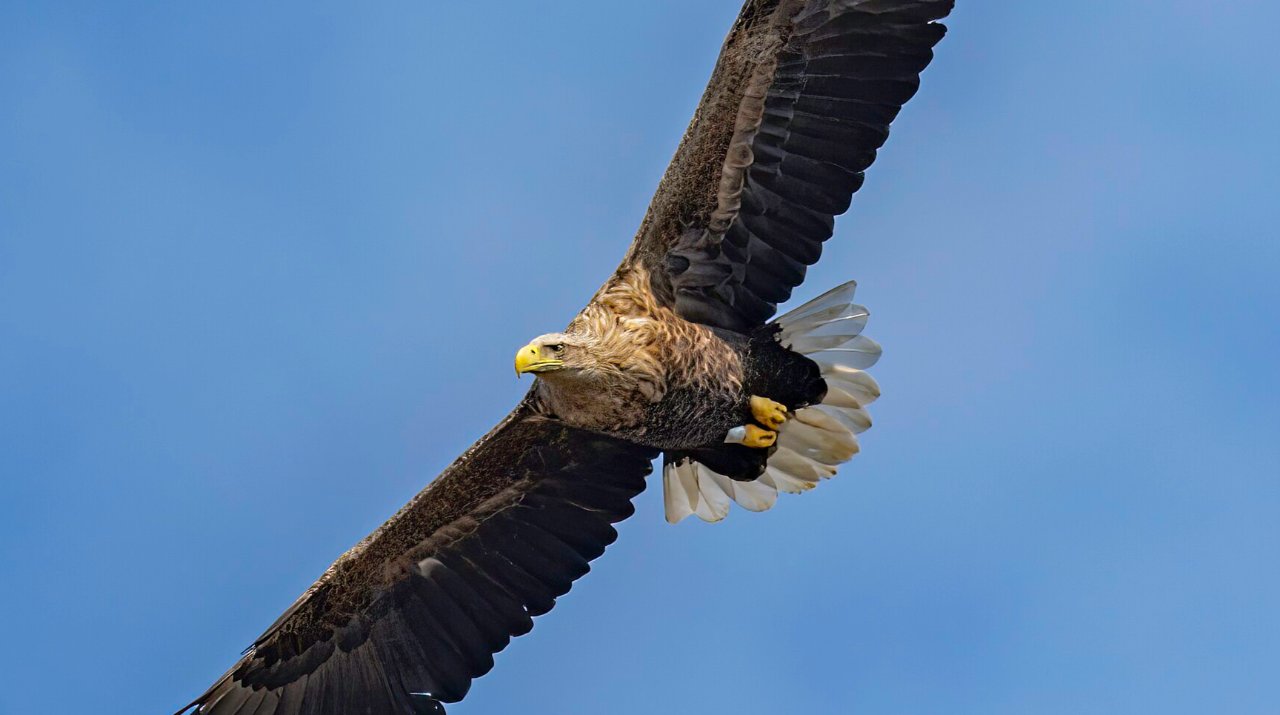
White-tailed Sea Eagle
Haliaeetus albicilla
Identify the White-tailed Sea Eagle by sound or photo and log your sightings with Birdpass.


The White-tailed Eagle is a huge sea eagle of northern Europe and Asia, living on coasts, fjords, archipelagos and large lakes and rivers. Adults are unmistakable, with broad “barn door” wings, a pale head, a massive yellow bill and a white, wedge-shaped tail. It takes fish and waterbirds and readily scavenges. After declines caused by persecution and pesticides, it has recovered strongly across much of Europe thanks to protection.
Did you know?
- Its vast, broad wings have earned it the nickname “flying barn door”.
- It forms a species pair with the Bald Eagle, filling a similar role in Eurasia.
About the species
Identification
A very large eagle with broad, rectangular wings and a fairly short, wedge-shaped tail. Adults have a pale head and neck, a clearly white tail and a large yellow bill; young birds are dark and mottled without a white tail, which whitens with age. Told from Golden Eagle especially by its tail and head: the White-tailed Eagle has a short, broad tail (white in adults) and a paler head, whereas Golden Eagle has a longer tail, darker overall colour and a golden nape; the White-tailed Eagle's wings look heavier and more plank-like.
Family
Accipitridae
Size
Very large (swan)
Colours
brown, white, yellow, black
About the habitat
Sea coasts, archipelagos, fjords and estuaries, as well as large lakes, rivers and wetlands; it needs quiet shores and old trees or cliffs for nesting.
Diet
Mainly fish and waterbirds, supplemented by carrion and offal; occasionally small to medium mammals. It often steals prey from other birds such as Ospreys and gulls.
Behaviour
Often seen soaring on long, broad, flat wings or perched prominently on shores. It hunts by cruising low over water or swooping from a perch to snatch prey from the surface, and scavenges readily. Pairs are usually long-term and territorial, reusing huge stick nests in tall trees or on cliffs and adding to them year after year. It lays 1–3 eggs, but usually only one chick is raised.
Sources
Photo: Bengt Nyman from Vaxholm, Sweden, CC BY-SA 2.0 https://commons.wikimedia.org/wiki/File:NZ7 5265 (52812350718).jpg
Text: GBIF regional observations + Wikipedia (Danish) + FinBIF species descriptions + GBIF regional observations + Wikipedia (Icelandic) + GBIF regional observations + Wikipedia (English), GBIF occurrence data; Wikipedia: CC BY-SA 4.0; FinBIF: CC BY 4.0 https://da.wikipedia.org/wiki/Hav%C3%B8rn
.jpg)