
 Suomi
 Svenska
 Polski
 Čeština
 Slovenčina
 Norsk
 Dansk
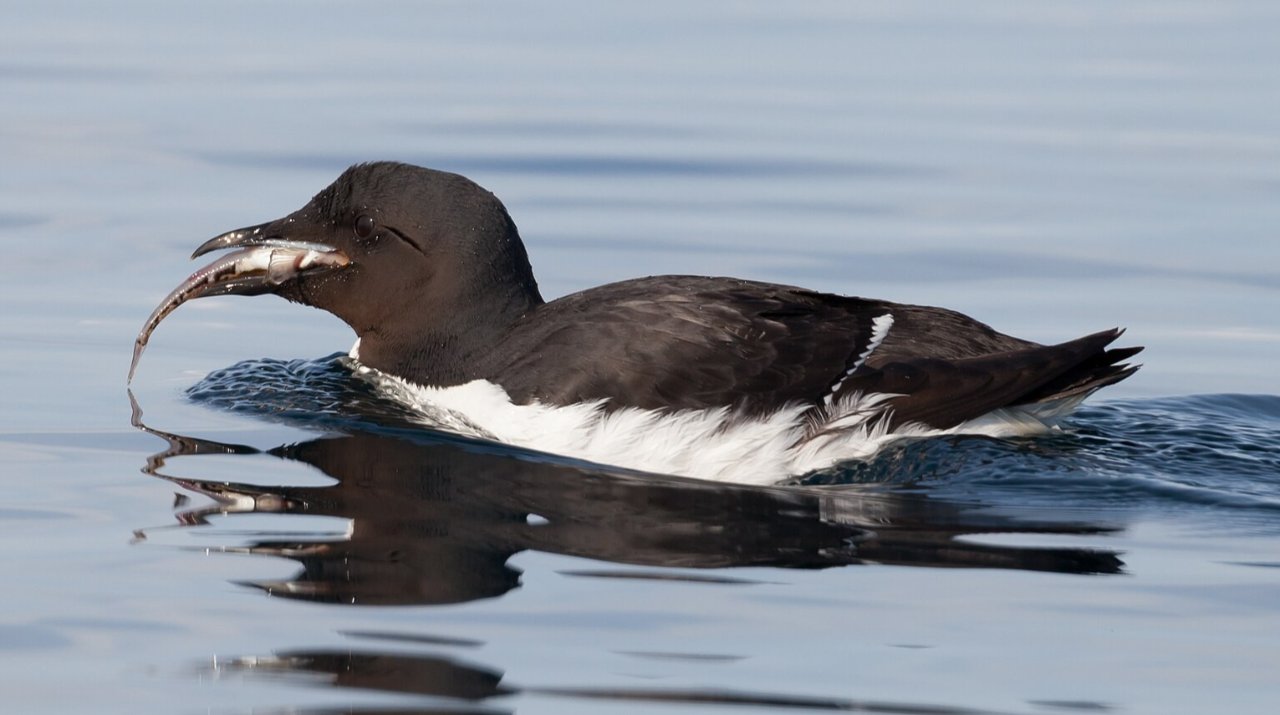
Thick-billed Murre
Uria lomvia
Identify the Thick-billed Murre by sound or photo and log your sightings with Birdpass.


The Thick-billed Murre, or Brünnich's Guillemot, is a sturdy auk of the high Arctic that spends most of its life on icy seas and comes ashore only to breed. It nests in huge, densely packed colonies on cliff ledges. It has a dark head and back, white underparts and a thick, pointed bill with a pale line along the gape. It moves south in winter only far enough to find ice-free water.
Did you know?
- It has the smallest territory of any bird – less than a hand's breadth of ledge.
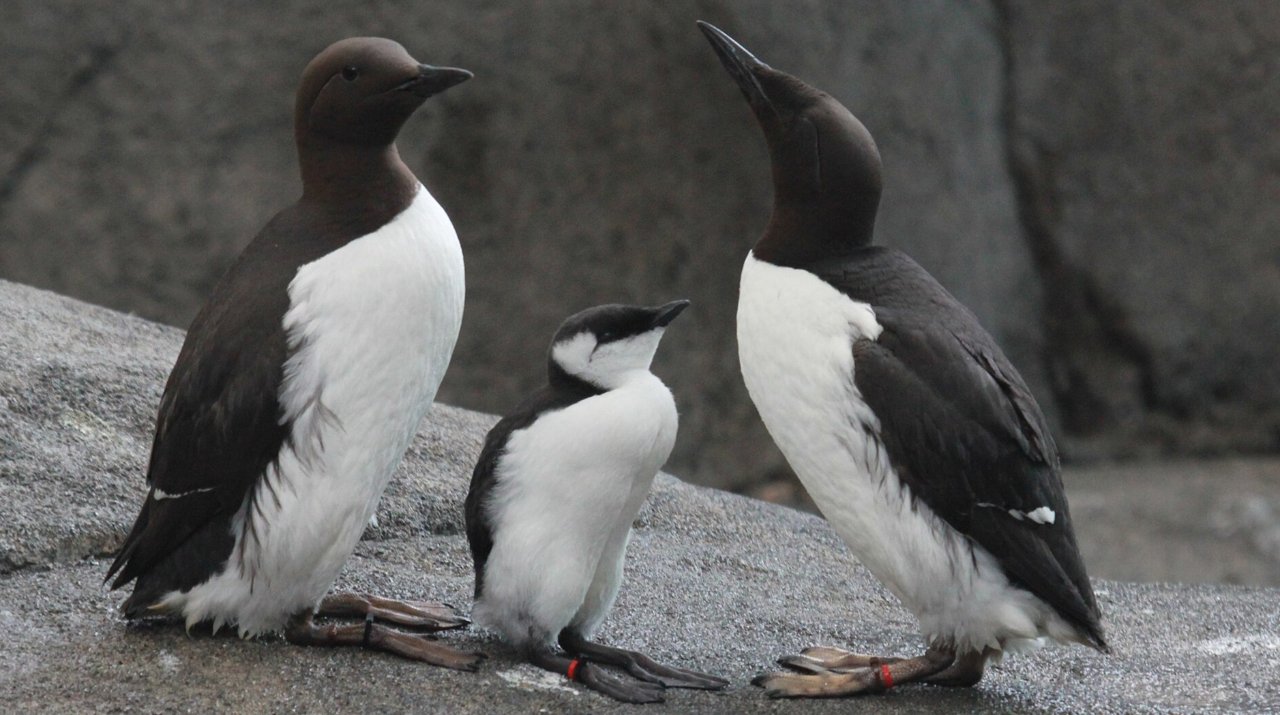
- Its chicks leap from the cliffs at night, with the father gliding down after them.
About the species
Identification
The adult has a black head and back and white breast and belly and stands upright on land. It is slightly larger than Common Guillemot. Its bill is clearly thicker and shorter than the Common Guillemot's, with a pale line along the gape, which helps separate them; the overall look is more massive, with blacker upperparts and unstreaked flanks. In summer the white of the breast forms a sharp point into the black throat.
Family
Alcidae
Size
Large (crow)
Colours
black, white
About the habitat
Cold Arctic and subarctic seas, mostly below about 5 °C; breeds on narrow ledges of steep sea cliffs and winters at the edge of the ice.
Diet
Fish such as Arctic cod and capelin, squid and crustaceans, caught by deep wing-propelled dives; it brings single prey items to its chick.
Behaviour
Breeds in vast cliff colonies where pairs lay a single egg on bare rock and both parents share incubation and chick-rearing. Colonies are noisy with harsh, growling calls, but birds are quiet at sea. Chicks leave the ledges at 18–25 days, gliding down to the sea at night, and travel with their father for several weeks.
Sources
Photo: AWeith, CC BY-SA 4.0 https://commons.wikimedia.org/wiki/File:A Brünnich's guillemot (Uria lomvia) with prey.jpg
Text: Wikipedia (English), CC BY-SA 4.0 https://en.wikipedia.org/wiki/Thick-billed_murre
 with prey.jpg)