
 Suomi
 Svenska
 Polski
 Čeština
 Slovenčina
 Norsk
 Dansk
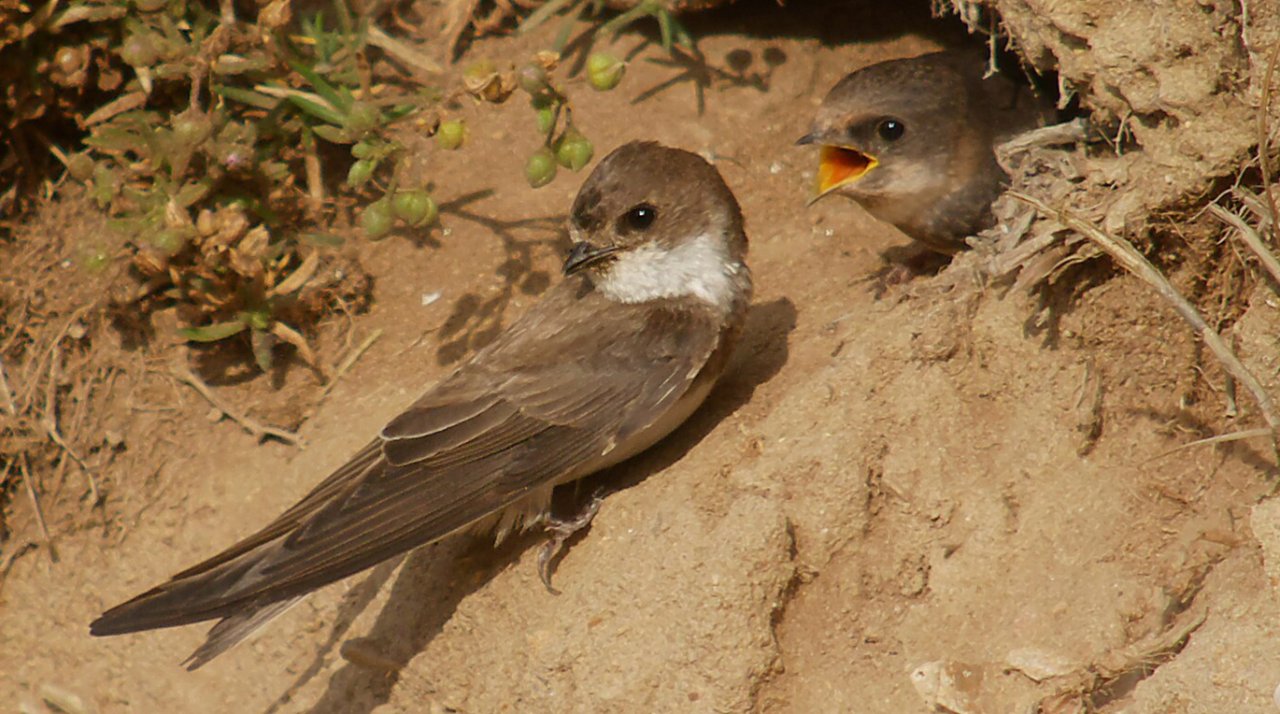
Sand Martin
Riparia riparia
Identify the Sand Martin by sound or photo and log your sightings with Birdpass.


The Sand Martin is a small, brown-and-white swallow with a dark breast band and a fast, flickering flight. It breeds across the Holarctic and winters in Africa, southern Asia and South America. Highly social, it nests in colonies in burrows dug into sandy banks, often near water. It is usually among the first swallows to return in spring.
Did you know?
- In the Americas it is called the Bank Swallow.
- Its nest tunnels can be up to a metre long.
Voice
About the species
Identification
A small swallow, brownish-grey above and pale below, with a clear brown breast band; the tail is slightly forked. The call is a rasping chirp. It lacks the Barn Swallow's long tail streamers and red throat, and the House Martin's white rump; the breast band is the key mark.
Family
Hirundinidae
Size
Tiny (goldcrest)
Colours
brown, white, grey
About the habitat
Open landscapes near water with steep sandy or gravelly banks – river banks, lakeshores, coastal cliffs, gravel pits and quarries.
Diet
Tiny flying insects, especially midges and other flies with aquatic larvae, caught in flight over water and open ground.
Behaviour
A fast, jerky flier that hawks insects low over water. Strongly colonial, with dozens to hundreds of pairs, it digs nesting tunnels up to a metre long in sandy faces with its feet and bill. It gives a dry, rasping twitter and gathers in large reedbed roosts in late summer. It leaves early in autumn.
Sources
Photo: Frank Vassen from Brussels, Belgium, CC BY 2.0 https://commons.wikimedia.org/wiki/File:Sand martin (Riparia riparia), Guidel-Plage, Brittany, France (19765483180).jpg
Sound: Pascal Christe, XC487832, CC BY-SA 4.0 https://xeno-canto.org/487832
Sound: Sonothèque ADVL, XC931385, CC0 1.0 https://xeno-canto.org/931385
Text: Wikipedia (English) + FinBIF species descriptions, CC BY-SA 4.0; FinBIF: CC BY 4.0 https://en.wikipedia.org/wiki/Sand_martin
, Guidel-Plage, Brittany, France (19765483180).jpg)