
 Suomi
 Svenska
 Polski
 Čeština
 Slovenčina
 Norsk
 Dansk
Rook
Corvus frugilegus
Identify the Rook by sound or photo and log your sightings with Birdpass.


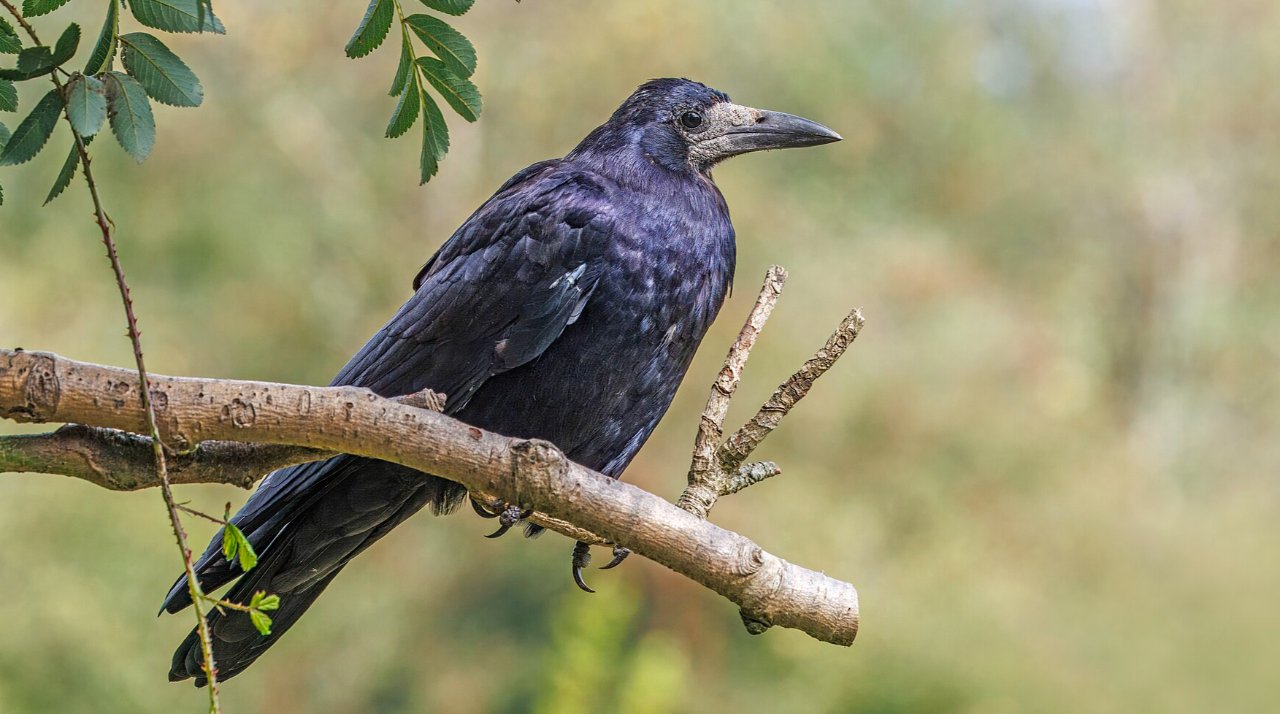
The Rook is a large, highly social black crow of the Palearctic, from western Europe to eastern Siberia, recognised by the whitish, bare skin around the base of its bill. It nests in large, noisy colonies – rookeries – high in tall trees near farms and villages and forages in flocks on fields. Many populations are resident, while northern and eastern birds move south-west in winter. Like other corvids, it is notably intelligent.
Did you know?
- The word “rookery” comes from the Rook's colonial nesting.
- Rooks have even been trained to pick up litter in a French theme park.
Voice
About the species
Identification
A medium-sized black crow with a rounded body and steep forehead. The bill is pointed and pale; adults have a bare, greyish bill base, a good field mark. The feathered legs look like baggy “trousers”, and the plumage is all black with a purplish sheen. Told from Carrion Crow by the bare pale bill base and head shape; young birds may still have a feathered, darker bill base.
Family
Corvidae
Size
Large (crow)
Colours
black, blue, grey
About the habitat
Open farmland with pastures and arable fields and tall trees for nesting; also parks, villages and small towns. Avoids extensive forest and moors.
Diet
An omnivore: earthworms, insect larvae and beetles probed from fields and pastures, as well as grain, seeds, fruit, carrion and occasionally eggs or small vertebrates; also food scraps in towns.
Behaviour
Highly gregarious year-round; pairs stay together for life within the flock. Birds gather at the rookery in the evening, then move to communal roosts and disperse to feed at dawn. It walks and probes the soil with its long bill. Flocks may perform agile aerial displays in autumn. It has shown tool use and problem-solving in experiments.
Sources
Photo: Charles J. Sharp, CC BY-SA 4.0 https://commons.wikimedia.org/wiki/File:Rook (Corvus frugilegus) Heligan.jpg
Sound: Sonothèque ADVL, XC815467, CC0 1.0 https://xeno-canto.org/815467
Sound: Sonothèque ADVL, XC707407, CC0 1.0 https://xeno-canto.org/707407
Text: Wikipedia (English) + GBIF regional observations + Wikipedia (English) + FinBIF species descriptions, CC BY-SA 4.0; GBIF occurrence data; Wikipedia: CC BY-SA 4.0; FinBIF: CC BY 4.0 https://en.wikipedia.org/wiki/Rook_(bird)
 Heligan.jpg)