
 Suomi
 Svenska
 Polski
 Čeština
 Slovenčina
 Norsk
 Dansk
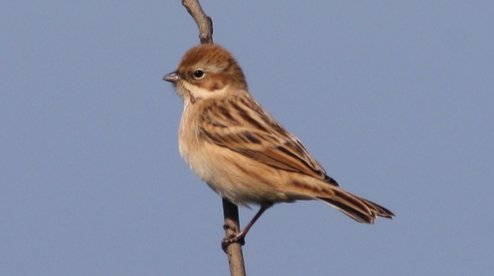
Pallas's Reed Bunting
Emberiza pallasi
Identify the Pallas's Reed Bunting by sound or photo and log your sightings with Birdpass.


Pallas's Reed Bunting is a small bunting that breeds across northern and central Asia to Mongolia and winters in eastern and Southeast Asia. It breeds in tundra scrub and willow thickets near water, and also in drier, open habitats such as open larch forest. Males have a black head and throat set off by a white collar and a grey-and-white back, while females are browner and closely resemble Reed Bunting.
Did you know?
- It is named after the naturalist Peter Simon Pallas.
- Although an Asian species, it has turned up as a very rare vagrant in western Europe.
Voice
About the species
Identification
Length 12–13.5 cm. The breeding male has a black head and white underparts, with grey-and-white upperparts lacking chestnut tones; the bill is finer than Reed Bunting's. Females and young resemble Reed Bunting, but a reliable mark is the pinkish lower mandible (Reed Bunting's bill is all grey); the upper mandible is also straight (slightly convex in Reed Bunting). The call is sparrow-like.
Family
Emberizidae
Size
Small (sparrow)
Colours
brown, white, black
About the habitat
Tundra scrub and willow thickets along rivers, lakes and bogs, and drier open areas such as open larch forest; on migration various scrub and reedbeds.
Diet
Mainly seeds; nestlings are fed insects and other small invertebrates.
Behaviour
Forages low in shrubs and reeds. The male's simple song is a repeated “sherp”, and the call is sparrow-like. Breeding lasts from June to August; it nests in a bush, weaving a cup of grasses and sedges, and lays 3–5 eggs, incubated for about 11 days. Adults moult completely on the breeding grounds in late summer.
Sources
Photo: Rémi Bigonneau, CC BY-SA 3.0 https://commons.wikimedia.org/wiki/File:Emberiza pallasi (10).jpg
Sound: Jochem Verweij, XC931499, CC BY-SA 4.0 https://xeno-canto.org/931499
Text: Wikipedia (English) + GBIF regional observations + Wikipedia (Finnish), CC BY-SA 4.0; GBIF occurrence data; Wikipedia: CC BY-SA 4.0 https://en.wikipedia.org/wiki/Pallas%27s_reed_bunting
.jpg)