Suomi
 Svenska
 Polski
 Čeština
 Slovenčina
 Norsk
 Dansk
Pallas's Leaf Warbler
Phylloscopus proregulus
Identify the Pallas's Leaf Warbler by sound or photo and log your sightings with Birdpass.


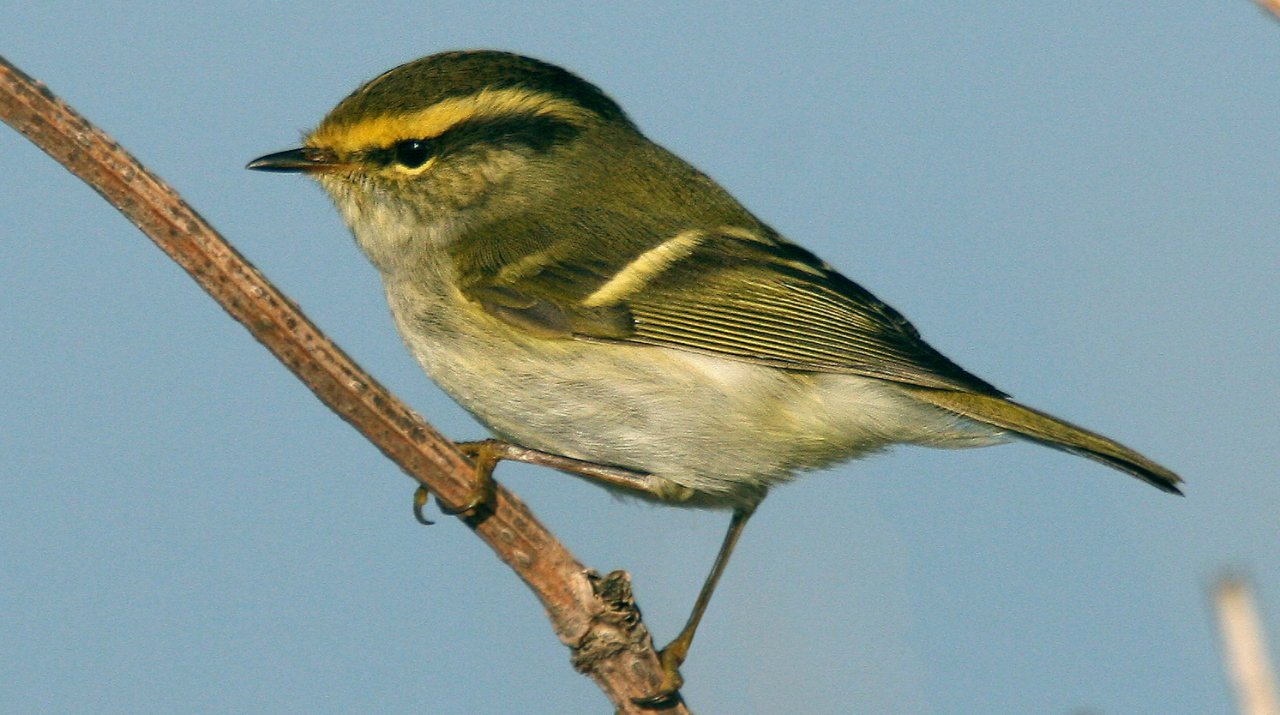
Pallas's Leaf Warbler is one of the tiniest Palearctic warblers, a lively green-and-white sprite with a lemon-yellow rump, a bold yellow supercilium and crown stripe and two wing bars. It breeds in mountain and taiga forests from southern Siberia and Mongolia to north-east China and winters in southern China and Southeast Asia. It is a regular late-autumn vagrant to western Europe.
Did you know?
- It is named after the naturalist Peter Simon Pallas.
- Differences in voice, later confirmed by DNA, led to several of its former subspecies being split.
About the species
Identification
A tiny leaf warbler, the size of a Goldcrest, with a very bold head pattern: a dark crown, a broad yellowish supercilium and a pale central crown stripe. The wing shows two clear wing bars, and the rump is pale yellow, flashing when the bird hovers. The call is a clear “dweet”. It differs from Yellow-browed Warbler in its crown stripe and yellow rump.
Family
Sylviidae
Size
Tiny (goldcrest)
Colours
green, yellow, white
About the habitat
Breeds in taiga and mountain forest dominated by spruce, fir and larch; in winter a wider range of woodland, edges, parks and scrub.
Diet
Small insects and spiders – adults, larvae, pupae and eggs – gleaned from leaves and twigs or taken while hovering.
Behaviour
An agile, high-energy forager in the outer branches, often hovering to pick prey from foliage and joining mixed flocks of tits and kinglets. The female builds a cup nest in a tree or shrub and lays 4–6 eggs; incubation lasts 12–13 days, and the young fledge at 12–14 days. Its song is a loud, varied series of whistles and trills, and its call a soft, rising “dweet”.
Sources
Photo: christoph_moning, CC BY 4.0 https://commons.wikimedia.org/wiki/File:Goldhähnchen-Laubsänger, Heligoland, Germany 2.jpg
Text: Wikipedia (English) + FinBIF species descriptions, CC BY-SA 4.0; FinBIF: CC BY 4.0 https://en.wikipedia.org/wiki/Pallas%27s_leaf_warbler