Suomi
 Svenska
 Polski
 Čeština
 Slovenčina
 Norsk
 Dansk
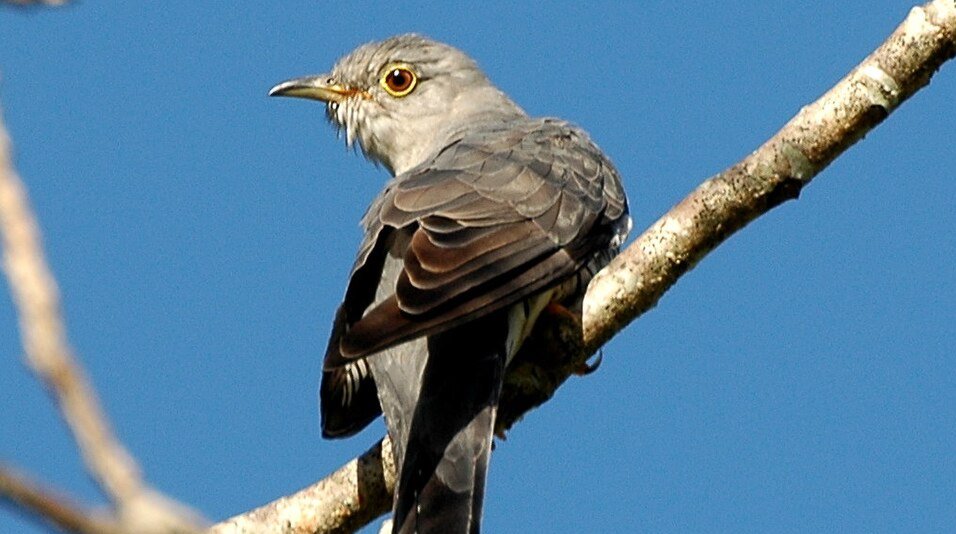
Oriental Cuckoo
Cuculus optatus
Identify the Oriental Cuckoo by sound or photo and log your sightings with Birdpass.


The Oriental Cuckoo is a secretive forest cuckoo of northern Eurasia, from the Urals and European Russia east to Kamchatka and Japan. It was long lumped with the Himalayan Cuckoo but is now treated as a separate species based on voice and size. It closely resembles the Common Cuckoo but has a low, even “poo-poo” call. It is a brood parasite, mainly of leaf warblers, and winters from South-East Asia to Australia.
Did you know?
- The male's soft, paired “poo-poo” call recalls a Hoopoe's voice.
- Rufous-morph birds are barred even across the rump, unlike rufous Common Cuckoos.
Voice
About the species
Identification
About 30–32 cm long. The male is grey above and on the breast, and the creamy belly has dense dark bars; the bare eye-ring is yellow and the legs orange-yellow. Females and young occur in a grey morph (brownish tinge on the breast) and a rufous morph in which dark bars cover the whole plumage including the rump. It is usually slightly slimmer than the Common Cuckoo, which is on average larger and longer-winged, paler grey and more finely barred below; the Common Cuckoo's undertail is usually white with dark bars, whereas the Oriental Cuckoo's is often warm buff and sparsely marked. The male's even, low, two-syllable “poo-poo” series helps identification.
Family
Cuculidae
Size
Medium (thrush)
Colours
grey, white, black, yellow
About the habitat
Coniferous, deciduous and mixed forests with dense canopy and undergrowth; in winter forests and forest edges in South-East Asia and Australasia.
Diet
Mainly insects and their larvae, especially hairy caterpillars, gleaned from trees and shrubs and taken from the ground.
Behaviour
Quiet and elusive, keeping within the forest canopy and making short foraging sallies. In the breeding season males repeat a low, paired “poo-poo” call reminiscent of a Hoopoe; it is usually silent otherwise. It lays its eggs in the nests of small songbirds, especially Phylloscopus warblers, and the chick ejects the host's eggs or young soon after hatching.
Sources
Photo: Aviceda, CC BY-SA 3.0 https://commons.wikimedia.org/wiki/File:Oriental Cuckoo Maiala.JPG
Sound: Jidanni, CC BY-SA 4.0 https://commons.wikimedia.org/wiki/File:Bugu.ogg
Text: Wikipedia (English) + GBIF regional observations + Wikipedia (English), CC BY-SA 4.0; GBIF occurrence data; Wikipedia: CC BY-SA 4.0 https://en.wikipedia.org/wiki/Oriental_cuckoo