
 Suomi
 Svenska
 Polski
 Čeština
 Slovenčina
 Norsk
 Dansk
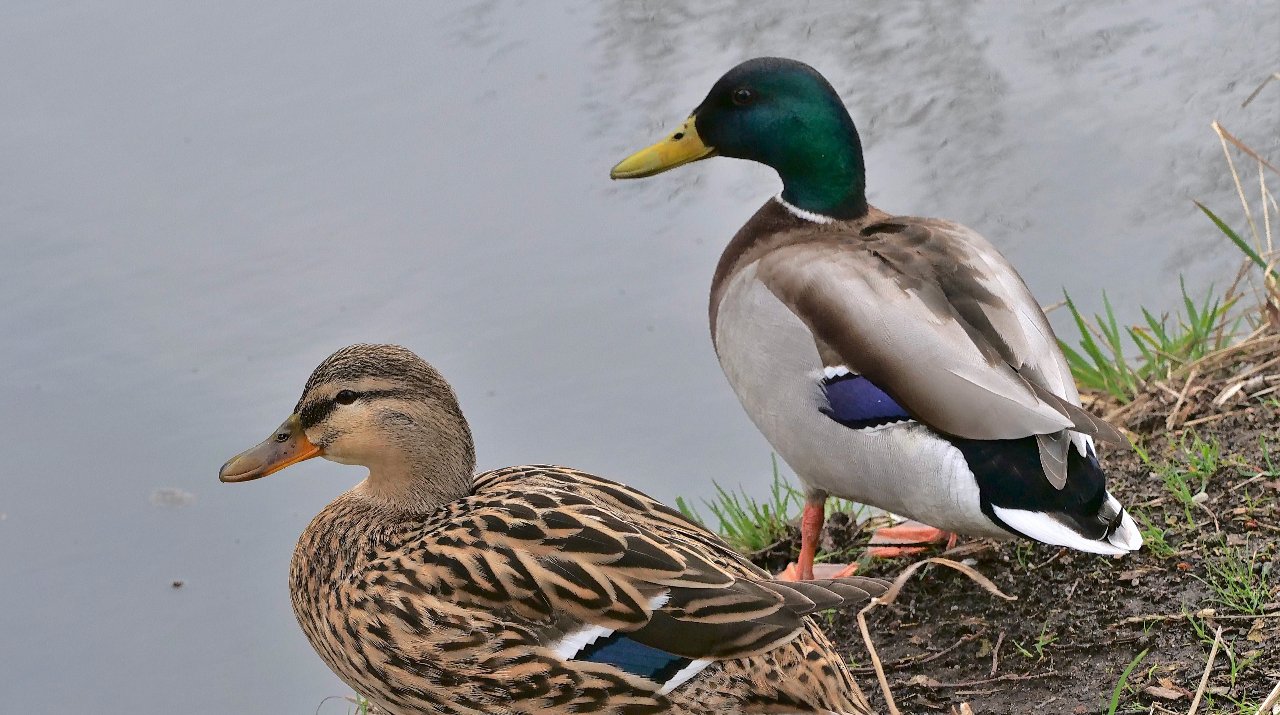
Mallard
Anas platyrhynchos
Identify the Mallard by sound or photo and log your sightings with Birdpass.


The Mallard is a familiar, medium-large dabbling duck found across temperate and subtropical parts of the Northern Hemisphere and introduced widely elsewhere. Males are instantly recognised by their glossy green heads, while females are mottled brown; both sexes show a white-edged blue speculum. Exceptionally adaptable, it thrives from wild marshes to city parks. It is the ancestor of most domestic ducks and readily hybridises with related species.
Did you know?
- Most domestic duck breeds are descended from the Mallard.
- Female Mallards can occasionally develop male-like plumage if their ovaries stop functioning.
Voice
About the species
Identification
A medium-sized duck (50–60 cm). The male has a glossy green head, yellow bill, white neck ring, chestnut breast and grey-brown body; the central tail feathers curl upwards. The female is mottled brown with a darker crown and clear eye-stripe, and the bill is variably orange and black. Both sexes show a blue, white-bordered speculum and orange legs; eclipse males resemble females but have a uniformly yellowish bill and darker breast.
Family
Anatidae
Size
Large (crow)
Colours
grey, green, brown, white, blue
About the habitat
Almost any water body: lakes, ponds, rivers, marshes, flooded fields and coastal bays, as well as urban parks.
Diet
Omnivorous: seeds, shoots, roots and grain, plus aquatic insects, snails, tadpoles and occasionally small fish; ducklings feed mainly on aquatic invertebrates.
Behaviour
Feeds by dabbling and up-ending in shallow water and grazes along shores. Seen in pairs or small groups, gathering in larger flocks outside the breeding season. The female gives the familiar loud quack; the male has a hoarser, nasal call. Females lay 8–13 eggs and incubate for about 28 days; the precocial ducklings swim immediately after hatching. Northern birds are migratory, while others winter on open water.
Sources
Photo: Rolf Dietrich Brecher from Germany, CC BY 2.0 https://commons.wikimedia.org/wiki/File:Anas platyrhynchos (mixed pair) (32428014687).jpg
Sound: Sonothèque ADVL, XC705891, CC0 1.0 https://xeno-canto.org/705891
Sound: Sonothèque ADVL, XC730554, CC0 1.0 https://xeno-canto.org/730554
Text: Wikipedia (English) + FinBIF species descriptions + Wikipedia (Finnish), CC BY-SA 4.0; FinBIF: CC BY 4.0; Wikipedia: CC BY-SA 4.0 https://en.wikipedia.org/wiki/Mallard
 (32428014687).jpg)