Suomi
 Svenska
 Polski
 Čeština
 Slovenčina
 Norsk
 Dansk
Grey Partridge
Perdix perdix
Identify the Grey Partridge by sound or photo and log your sightings with Birdpass.


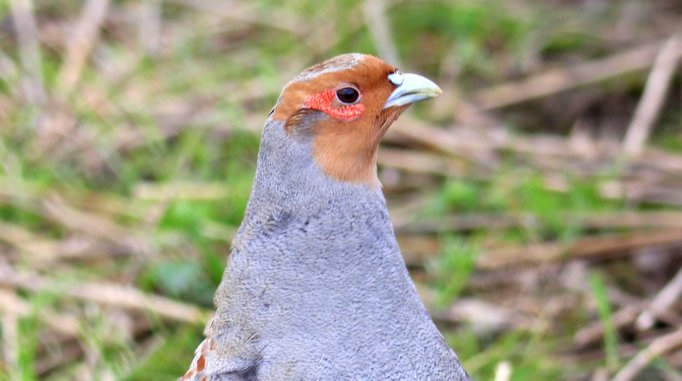
The Grey Partridge is a compact, ground-dwelling gamebird of open farmland across Europe and western Asia, and has been introduced to North America and elsewhere. It has an orange face, a grey breast, barred flanks and often a chestnut horseshoe on the belly. It has declined sharply in intensively farmed regions because of habitat loss, pesticides and the loss of insect prey for chicks.
Did you know?
- For their first days, chicks can digest only insects.
- In North America it is known as the “Hungarian partridge” or “hun”.
Voice
About the species
Identification
A stocky gamebird with a mottled brown back and greyish underparts; the male has a dark horseshoe-shaped patch on the belly, and the face is orange. The short tail is rufous, obvious in flight. Young birds are all brown before the early-autumn moult. The call is a short, grating “kirr-ik”.
Family
Phasianidae
Size
Large (crow)
Colours
grey, brown, orange, white
About the habitat
Open farmland, meadows, fallows and grassy field margins with low vegetation and scattered cover such as hedges.
Diet
Mainly seeds and green shoots of weeds and cereals, as well as buds and leaves; the chicks depend almost entirely on insects for their first weeks.
Behaviour
Spends most of its time on the ground, walking and pecking for food. It nests on the ground in dense grass or field margins, and hens may lay up to twenty eggs – one of the largest clutches of any bird. Pairs split into family coveys in autumn and winter. When flushed it makes a short, fast, whirring flight on rounded wings with harsh calls before dropping back into cover.
Sources
Photo: david galavan, CC BY 2.0 https://commons.wikimedia.org/wiki/File:Perdix perdix Turvey 3.jpg
Sound: Mikko Heikkinen, XC636092, CC BY 4.0 https://xeno-canto.org/636092
Text: Wikipedia (English) + FinBIF species descriptions, CC BY-SA 4.0; FinBIF: CC BY 4.0 https://en.wikipedia.org/wiki/Grey_partridge