Suomi
 Svenska
 Polski
 Čeština
 Slovenčina
 Norsk
 Dansk
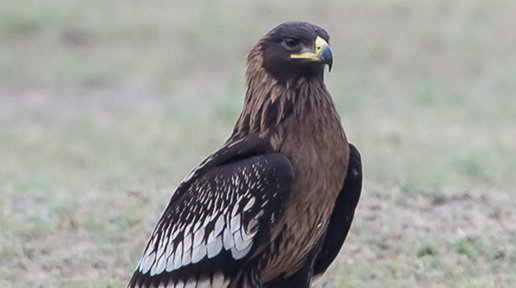
Greater Spotted Eagle
Clanga clanga
Identify the Greater Spotted Eagle by sound or photo and log your sightings with Birdpass.


The Greater Spotted Eagle is a large, dark brown booted eagle of eastern Europe, Russia and Central Asia that winters in southern Asia, the Middle East, the Mediterranean and north-east Africa. Unlike most of its relatives, it favours wet places – floodplains, bogs and wooded wetlands. It is classified as Vulnerable, threatened by habitat loss, electrocution and frequent hybridisation with the Lesser Spotted Eagle.
Did you know?
- The oldest chick in a nest often kills its younger sibling.
- The genus Clanga was split from Aquila after genetic studies.
About the species
Identification
A large eagle, very dark brown to almost black. Juveniles have large white teardrop spots on the wing coverts. At long range it is very hard to tell from Lesser Spotted Eagle, and the two can hybridise, which makes identification even more challenging.
Family
Accipitridae
Size
Very large (swan)
Colours
brown, black, white, yellow
About the habitat
Large, undisturbed wetlands – floodplains, bogs, marshes and swampy riverine forests; in winter wetlands and river valleys.
Diet
An opportunist that hunts and scavenges: small mammals, especially voles, frogs, waterbirds and other birds, occasionally reptiles and fish, as well as carrion, especially in winter.
Behaviour
A wary, migratory eagle that often hunts from perches or low glides over marshes and wet meadows. It builds a stick nest high in a large tree near wetlands; the female incubates while the male brings food. Broods are small, and the older chick often kills its sibling, so usually only one young fledges.
Sources
Photo: Koshy Koshy, CC BY 2.0 https://commons.wikimedia.org/wiki/File:Aquila clanga from Tal Chapar Wildlife Sanctuary.jpg
Text: Wikipedia (English) + FinBIF species descriptions, CC BY-SA 4.0; FinBIF: CC BY 4.0 https://en.wikipedia.org/wiki/Greater_spotted_eagle