
 Suomi
 Svenska
 Polski
 Čeština
 Slovenčina
 Norsk
 Dansk
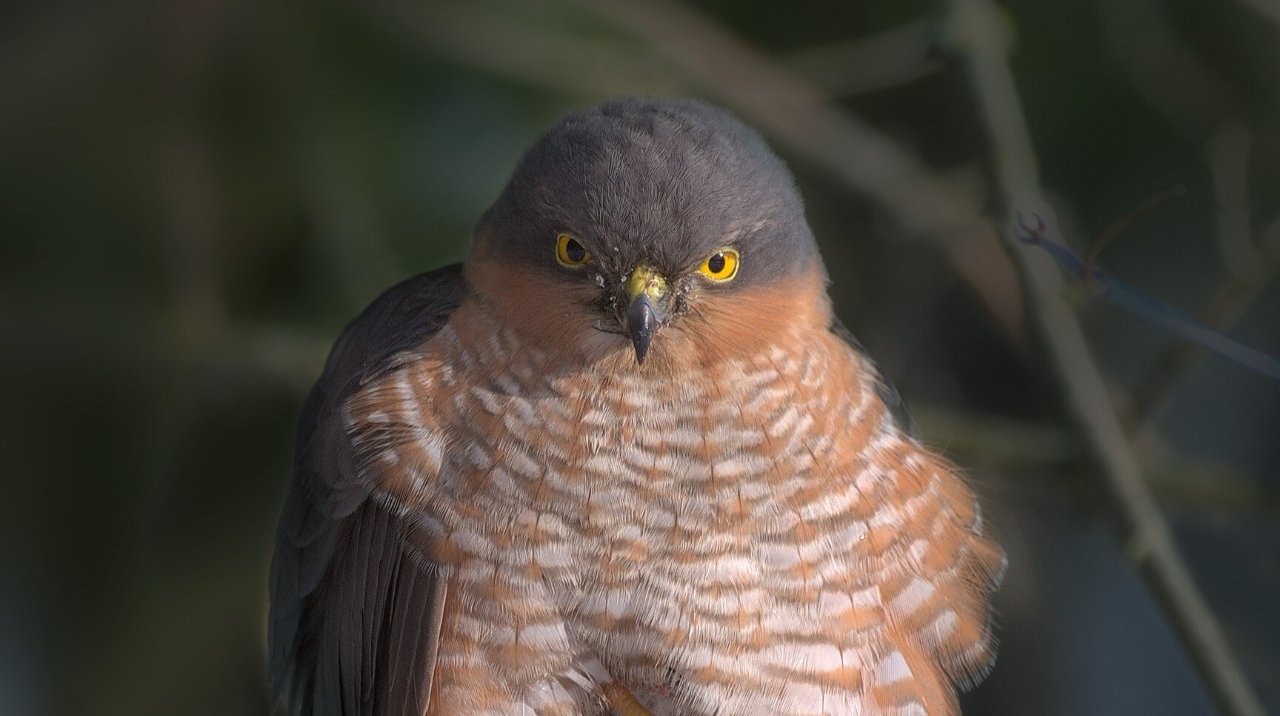
Eurasian Sparrowhawk
Accipiter nisus
Identify the Eurasian Sparrowhawk by sound or photo and log your sightings with Birdpass.


The Eurasian Sparrowhawk is a small, agile hawk widespread across the temperate and subtropical Old World. A woodland specialist that readily ventures into towns and gardens, it hunts mainly small birds, slipping through cover with short, rapid wingbeats and sudden dashes. After pesticide-related declines in the mid-20th century, populations have recovered and it is now of least concern.
Did you know?
- Females can be up to 25% larger than males – among the most extreme size differences between the sexes in any bird.
- Studies of racing-pigeon losses found that Eurasian Sparrowhawks caused less than 1% of deaths.
Voice
About the species
Identification
A small, agile hawk with short, rounded wings and a long, narrow tail; flies with quick wingbeats and short glides. The male is grey or blue-grey above and barred rufous below; the larger female is grey-brown above and densely barred below; juveniles have coarser markings. Told from Northern Goshawk by its much smaller size, slimmer build and lack of a bold pale eyebrow; unlike falcons, it has rounded wings and does not hover.
Family
Accipitridae
Size
Medium (thrush)
Colours
grey, white, orange, yellow
About the habitat
Woodland of many kinds, especially coniferous and mixed forest, as well as forest edges, hedgerows, parks and gardens in towns and cities.
Diet
Predominantly small to medium-sized birds taken by surprise. Males take smaller species such as tits, finches and sparrows, while the larger females often catch thrushes and starlings; occasionally small mammals and large insects.
Behaviour
A fast, stealthy ambush hunter that launches low attacks from cover and often targets birds at garden feeders; flight is flap-flap-glide with tight turns through trees. It often plucks prey at a regular perch. Northern populations migrate south for winter, while others are resident. It nests in trees, building a twig platform; the male brings food while the female incubates a clutch of usually 4–5 eggs.
Sources
Photo: Dion Art, CC BY-SA 4.0 https://commons.wikimedia.org/wiki/File:Ястреб-перепелятник (Accipiter nisus, m), Измайловский парк.jpg
Sound: Pascal Christe, XC925125, CC BY-SA 4.0 https://xeno-canto.org/925125
Text: Wikipedia (English) + FinBIF species descriptions, CC BY-SA 4.0; FinBIF: CC BY 4.0 https://en.wikipedia.org/wiki/Eurasian_sparrowhawk
, Измайловский парк.jpg)