Suomi
 Svenska
 Polski
 Čeština
 Slovenčina
 Norsk
 Dansk
Eurasian Oystercatcher
Haematopus ostralegus
Identify the Eurasian Oystercatcher by sound or photo and log your sightings with Birdpass.


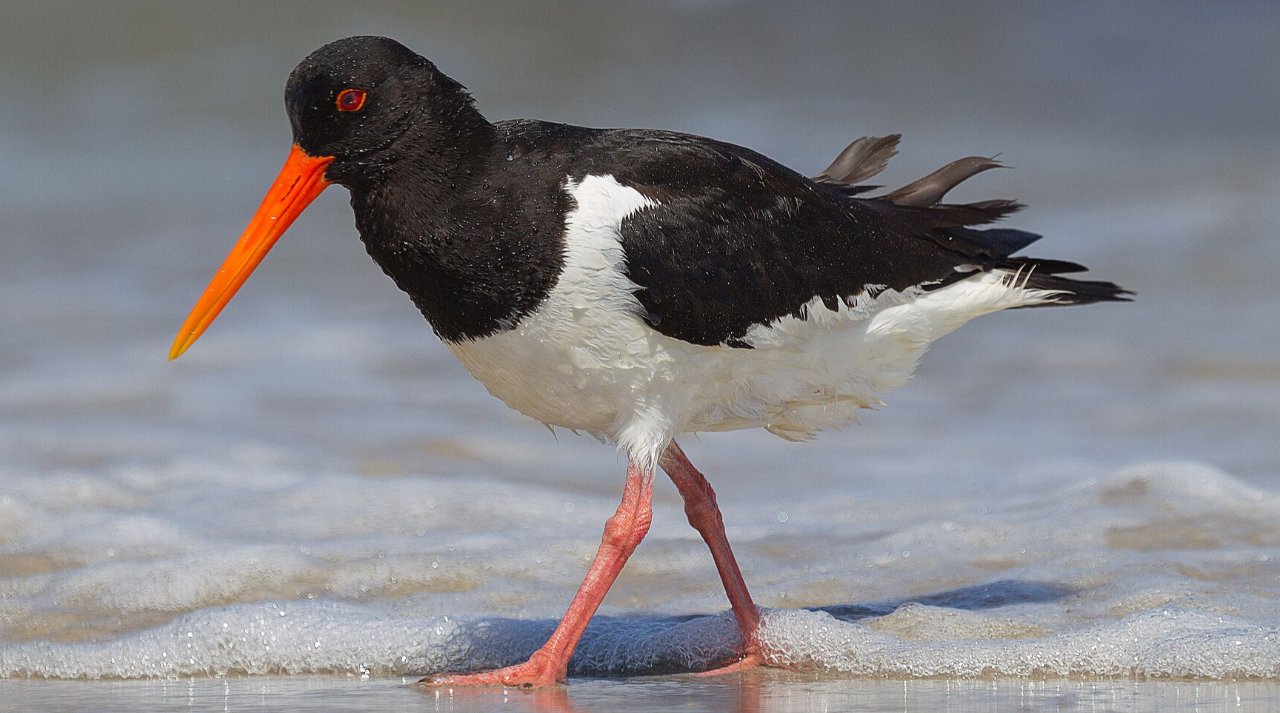
The Eurasian Oystercatcher is a bold black-and-white shorebird with a long, straight orange-red bill, red eye and pink legs. The most widespread oystercatcher, it breeds from western Europe across Eurosiberia to East Asia and is a familiar, noisy bird of coasts and estuaries, and in places inland shores and even flat roofs. Outside the breeding season it is highly gregarious, and many populations migrate to milder coasts in winter.
Did you know?
- Despite its name oysters make up only a small part of its diet, yet few other waders can open them at all.
- A ringed oystercatcher was recaptured 43 years after ringing, making it at least 46 years old.
Voice
About the species
Identification
A clearly black-and-white wader: black head, back and breast, white belly and bold white wing bars and rump in flight. The straight, strong orange-red bill and red legs are conspicuous; young birds have a brownish back and a dark bill tip. Its shrill, far-carrying call is a typical “kleep”.
Family
Haematopodidae
Size
Large (crow)
Colours
black, white, orange, red
About the habitat
Coasts, rocky islets, sandy beaches, estuaries and tidal flats; also lake and river shores, gravel islands and fields near water. In some towns it nests on flat roofs.
Diet
Mainly mussels and other bivalves, as well as earthworms, insect larvae and small crustaceans. Birds with blunt bills hammer or prise open shells, while those with pointed bills probe for worms; individuals often specialise in the technique learned from their parents.
Behaviour
Loud and conspicuous, often in pairs or small groups. Pairs often stay together for years and nest in a simple scrape on shingle, rocks or gravel. Both parents incubate and, unusually among waders, feed their chicks. They defend the nest with loud piping, distraction displays and attacks on predators. Outside the breeding season they form large flocks.
Sources
Photo: Andreas Trepte, CC BY-SA 2.5 https://commons.wikimedia.org/wiki/File:Haematopus ostralegus He.jpg
Sound: Olivier Grimm, XC561038, CC BY-SA 4.0 https://xeno-canto.org/561038
Sound: Sonothèque ADVL, XC730816, CC0 1.0 https://xeno-canto.org/730816
Text: Wikipedia (English) + FinBIF species descriptions + Wikipedia (Finnish), CC BY-SA 4.0; FinBIF: CC BY 4.0; Wikipedia: CC BY-SA 4.0 https://en.wikipedia.org/wiki/Eurasian_oystercatcher