
 Suomi
 Svenska
 Polski
 Čeština
 Slovenčina
 Norsk
 Dansk
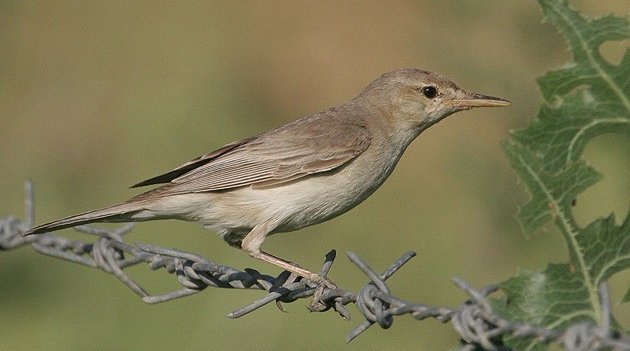
Eastern Olivaceous Warbler
Iduna pallida
Identify the Eastern Olivaceous Warbler by sound or photo and log your sightings with Birdpass.


The Eastern Olivaceous Warbler is a small, pale warbler that breeds from south-eastern Europe and the Middle East into western Asia and winters in sub-Saharan Africa and Arabia. Plain grey-brown above and whitish below, it has a strong, pointed bill and grey legs. Its song is a fast, nasal babble, and it constantly flicks its tail downwards.
Did you know?
- It habitually flicks its tail downward, unlike most warblers.
- Its species name, pallida, means “pale”.
About the species
Identification
A slim warbler about 12–14 cm long. The upperparts are greyish and the underparts whitish; the rump is clearly greyish. The tail has narrow pale edges and tip, and the bird dips its tail downwards. It resembles Blyth's Reed Warbler but is paler and less contrasting. Calls include a hard “tak”, and the song lacks mimicry.
Family
Sylviidae
Size
Tiny (goldcrest)
Colours
grey, brown, white
About the habitat
Dry open country with scattered bushes or trees, including farmland, gardens, olive groves and riverside scrub.
Diet
Mainly insects and other small invertebrates gleaned from foliage.
Behaviour
Active and restless, it constantly dips its tail downward. It sings a fast, nasal, babbling song. It nests low in bushes or undergrowth, usually laying two or three eggs; the sexes look alike.
Sources
Photo: Lior Kislev, CC BY-SA 4.0 https://commons.wikimedia.org/wiki/File:Eastern olivaceous warbler (Iduna pallida) by Lior Kislev.jpg
Text: Wikipedia (English), CC BY-SA 4.0 https://en.wikipedia.org/wiki/Eastern_olivaceous_warbler
 by Lior Kislev.jpg)