Suomi
 Svenska
 Polski
 Čeština
 Slovenčina
 Norsk
 Dansk
Arctic Warbler
Phylloscopus borealis
Identify the Arctic Warbler by sound or photo and log your sightings with Birdpass.


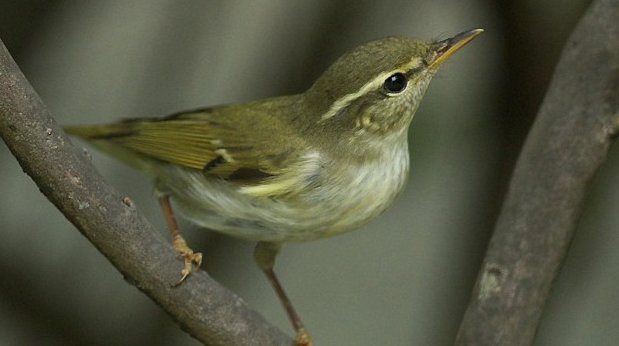
The Arctic Warbler is a leaf warbler of northern birch and mixed forests, breeding from northern Fennoscandia across the northern Palearctic to Alaska. The whole population winters in Southeast Asia – one of the longest migrations of any Old World insect-eating songbird. Greyish-green above and off-white below, it has a long pale supercilium, a single wing bar and a fast, trilling song.
Did you know?
- It is a regular autumn vagrant to western Europe.
- Populations once lumped with it are now separate species: the Kamchatka Leaf Warbler and Japanese Leaf Warbler.
About the species
Identification
Greenish-grey above and pale below, with a long pale supercilium and a dark eye stripe. It is separated from Willow Warbler by a clearer wing bar, stronger bill and bolder head pattern; it resembles Greenish Warbler. The call is a sharp “dzik” and the song a hammering, repeated phrase.
Family
Sylviidae
Size
Tiny (goldcrest)
Colours
green, white, yellow, brown
About the habitat
Birch and mixed birch-conifer forest, often near water, dense birch thickets and scrub in the north; winters in forests in Southeast Asia.
Diet
Mainly small insects and other invertebrates gleaned from leaves and twigs.
Behaviour
Active and restless, it forages among leaves and twigs and gives a sharp “dzik” call; the song is a fast, hammering, repeated trill. It nests low, usually on the ground in a hummock or bank, and a male may sometimes attend two females. It arrives late in spring and leaves early.
Sources
Photo: Arctic_Warbler_4683.jpg: Alnusderivative work: Osado, CC BY-SA 3.0 https://commons.wikimedia.org/wiki/File:Arctic Warbler 4683b.jpg
Text: Wikipedia (English) + FinBIF species descriptions + Wikipedia (Finnish), CC BY-SA 4.0; FinBIF: CC BY 4.0; Wikipedia: CC BY-SA 4.0 https://en.wikipedia.org/wiki/Arctic_warbler