Suomi
 Svenska
 Polski
 Čeština
 Slovenčina
 Norsk
 Dansk
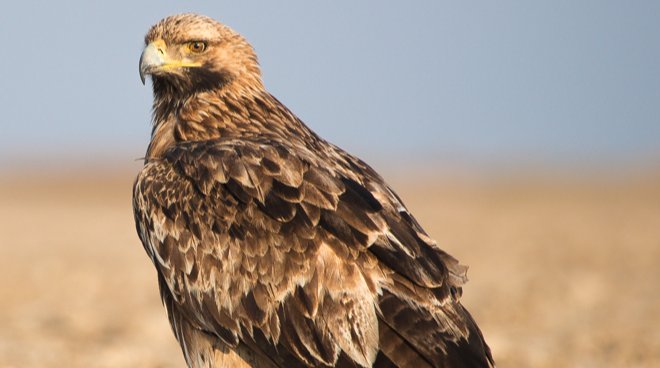
Eastern Imperial Eagle
Aquila heliaca
Identify the Eastern Imperial Eagle by sound or photo and log your sightings with Birdpass.


The Eastern Imperial Eagle is a large, dark eagle that breeds from south-eastern Europe across western and Central Asia and winters mainly in north-eastern Africa, the Middle East and southern and eastern Asia. It favours the edge where tall woodland meets open plains or steppe and nests high in mature trees. Its global population is small and declining, and it is listed as Vulnerable.
Did you know?
- Adults show white shoulder “epaulettes” that stand out against the dark plumage.
- It was once considered the same species as the Spanish Imperial Eagle.
About the species
Identification
72–80 cm long with a wingspan of 180–200 cm; slightly smaller and slimmer than Golden Eagle. Adults are very dark, almost black, with a clearly paler golden-buff crown and nape and white patches on the shoulders. Juveniles are pale brown with long streaks; the flight feathers and tail are dark, and the inner primaries form a pale “window” that helps identification.
Family
Accipitridae
Size
Very large (swan)
Colours
brown, yellow, orange, white
About the habitat
Woodland-steppe mosaics: tall woods bordering open, fairly flat country such as plains, steppe and farmland.
Diet
Mainly small and medium-sized mammals such as ground squirrels and hamsters, supplemented by birds and reptiles; it readily takes carrion.
Behaviour
Often perches upright on exposed lookouts such as trees, rocks, poles or mounds and is relatively tolerant of people for an Aquila eagle. Most populations migrate. Pairs nest in large, mature trees and usually raise one or two young.
Sources
Photo: Sumeet Moghe, CC BY-SA 3.0 https://commons.wikimedia.org/wiki/File:Eastern Imperial Eagle cr.jpg
Text: Wikipedia (English), CC BY-SA 4.0 https://en.wikipedia.org/wiki/Eastern_imperial_eagle