
 Suomi
 Svenska
 Polski
 Čeština
 Slovenčina
 Norsk
 Dansk
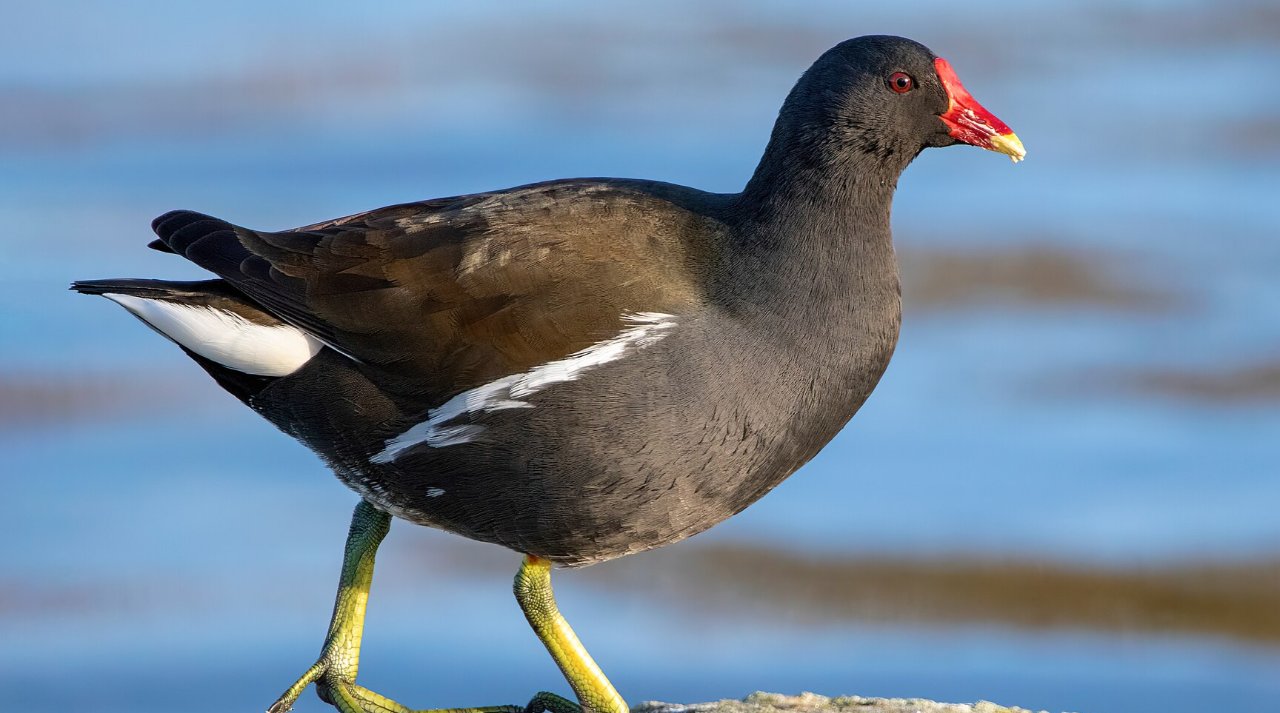
Common Moorhen
Gallinula chloropus
Identify the Common Moorhen by sound or photo and log your sightings with Birdpass.


The Common Moorhen is a familiar rail found across much of Europe, Africa and Asia around well-vegetated ponds, canals, marshes and park lakes. Adults are easily recognised by their dark body, white flank line and undertail, and red bill with a yellow tip below a red frontal shield. It swims confidently, walks on floating vegetation and often flicks its tail to show the white undertail.
Did you know?
- When danger looms, downy chicks may cling to a parent as it flies off, carrying them to safety.
- Its long toes spread its weight, letting it walk on lily pads and other floating plants.
Voice
About the species
Identification
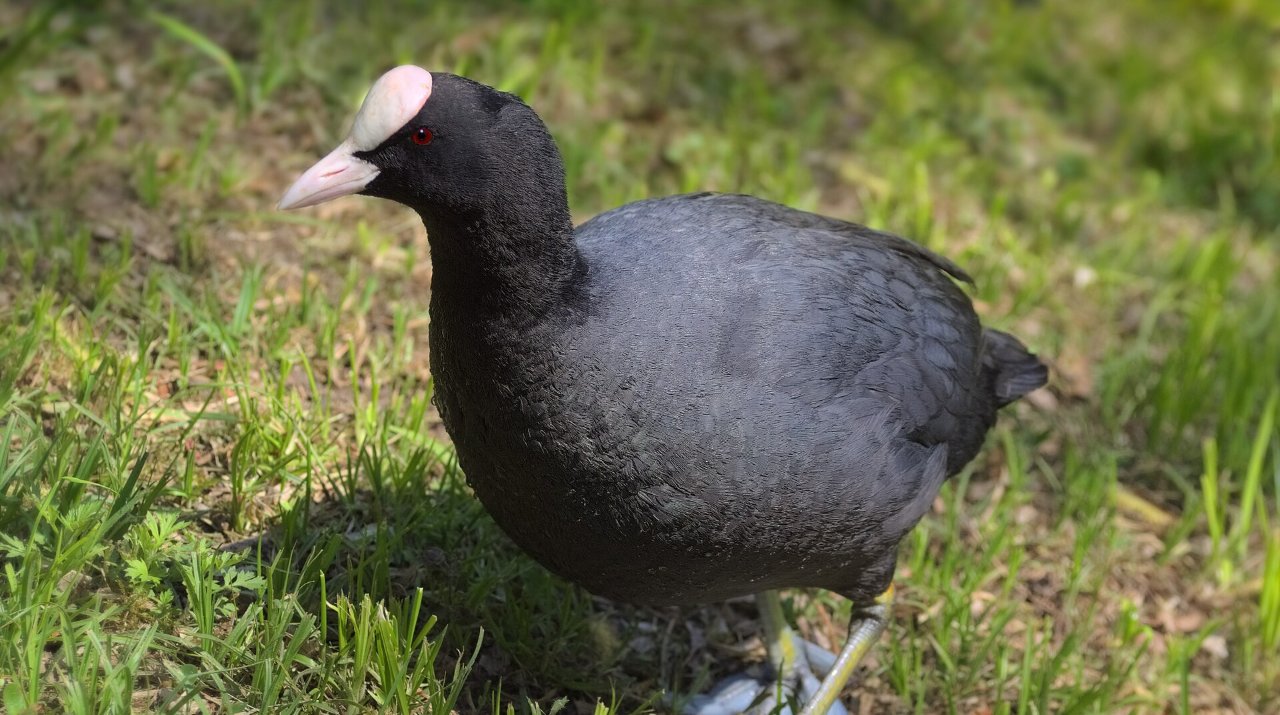
Adults have dark plumage, a brownish back, white undertail and a clear pale line along the flanks; the bill is red with a yellow tip, the frontal shield red and the legs greenish. Young birds are browner with a greenish bill and shield. The red bill and white flank line separate it from Coot, which has a white bill and shield and more uniform dark grey plumage.
Family
Rallidae
Size
Large (crow)
Colours
black, brown, red, white, yellow
About the habitat
Freshwater wetlands with dense emergent vegetation – reedbeds, pond and lake margins, marshy ditches, canals and slow rivers; also park lakes and urban wetlands.
Diet
Omnivorous: aquatic plants, seeds, shoots and algae, as well as insects, snails, worms, small crustaceans, tadpoles and small fish. It picks food along the water's edge and on floating vegetation, sometimes upending in shallow water.
Behaviour
Often skulking but also seen in open water, swimming with a jerky head-bob and flicking its tail. Territorial when breeding, even towards ducks; it gives sharp clucks and gurgling calls and hisses when threatened. It builds a basket-like nest in dense vegetation; both parents incubate and raise the young, and older offspring sometimes help feed a later brood. Birds from freezing areas move to milder regions in winter.
Sources
Photo: Alexis Lours, CC BY 4.0 https://commons.wikimedia.org/wiki/File:Common moorhen (Gallinula chloropus) France.jpg
Sound: Sonothèque ADVL, XC919424, CC0 1.0 https://xeno-canto.org/919424
Sound: Joost van Bruggen, XC436938, CC BY-SA 4.0 https://xeno-canto.org/436938
Sound: Sonothèque ADVL, XC919286, CC0 1.0 https://xeno-canto.org/919286
Text: Wikipedia (English) + FinBIF species descriptions, CC BY-SA 4.0; FinBIF: CC BY 4.0 https://en.wikipedia.org/wiki/Common_moorhen
 France.jpg)