
 Suomi
 Svenska
 Polski
 Čeština
 Slovenčina
 Norsk
 Dansk
Common Merganser
Mergus merganser
Identify the Common Merganser by sound or photo and log your sightings with Birdpass.


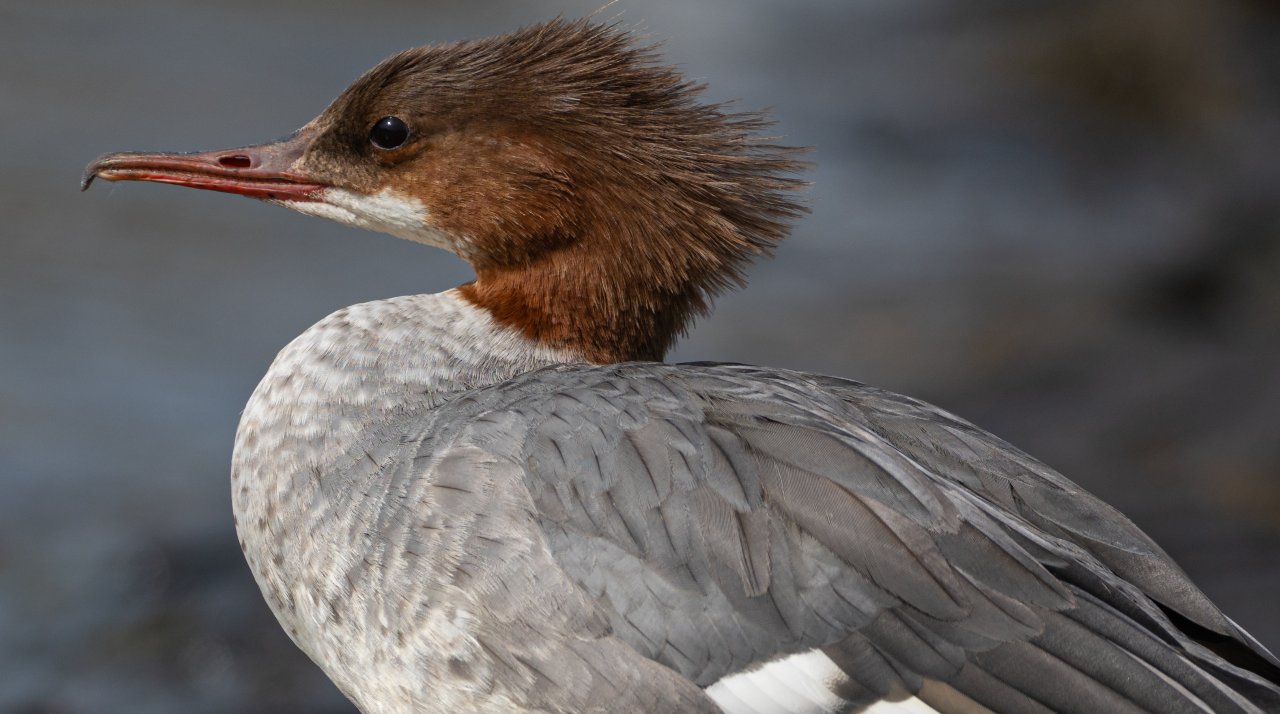
The Goosander, or Common Merganser, is a large, fish-eating duck of clear rivers and lakes across the forested north of Europe, Asia and North America. Males are white-bodied with a dark green head, while females are grey with a chestnut head and a clean white chin. A classic “sawbill”, it grips slippery fish with its long, narrow, serrated red bill. It nests in tree holes and moves only as far as needed to find open water in winter.
Did you know?
- Single females have been seen shepherding more than 70 ducklings.
- Its narrow “sawbill” has fine serrations for gripping fish.
Voice
About the species
Identification
A large, long-bodied waterbird with a black-and-white or grey body, a fairly long neck and a narrow red bill. The male has a dark green head and a salmon-tinged white body; the female has a rufous-brown head with a shaggy rear crest, a grey body and a sharply demarcated white chin. Young males resemble females. Told from Red-breasted Merganser by the female's sharp border between the chestnut head and grey neck and its heavier bill.
Family
Anatidae
Size
Very large (swan)
Colours
white, grey, brown, black, green
About the habitat
Clear, fish-rich rivers and deep lakes in forested or hilly regions; in winter large ice-free rivers, reservoirs and sheltered coasts.
Diet
Mainly fish, as well as aquatic invertebrates such as molluscs, crustaceans and insect larvae, and occasionally amphibians. Ducklings start on insect larvae and fish fry.
Behaviour
A strong diver that chases fish underwater, often hunting cooperatively in lines or semicircles to drive fish into shallows. It rests on rocks, banks and ice edges, swims low and flies with fast, strong wingbeats. It nests in tree holes, nest boxes or, in treeless areas, cliff crevices; the ducklings jump from the nest soon after hatching, and females sometimes lead huge crèches.
Sources
Photo: Hobbyfotowiki, CC0 https://commons.wikimedia.org/wiki/File:Goosander (Eurasian) (Mergus merganser).jpg
Sound: Pascal Christe, XC513502, CC BY-SA 4.0 https://xeno-canto.org/513502
Text: Wikipedia (English) + FinBIF species descriptions, CC BY-SA 4.0; FinBIF: CC BY 4.0 https://en.wikipedia.org/wiki/Common_merganser
 (Mergus merganser).jpg)