Suomi
 Svenska
 Polski
 Čeština
 Slovenčina
 Norsk
 Dansk
Common Goldeneye
Bucephala clangula
Identify the Common Goldeneye by sound or photo and log your sightings with Birdpass.


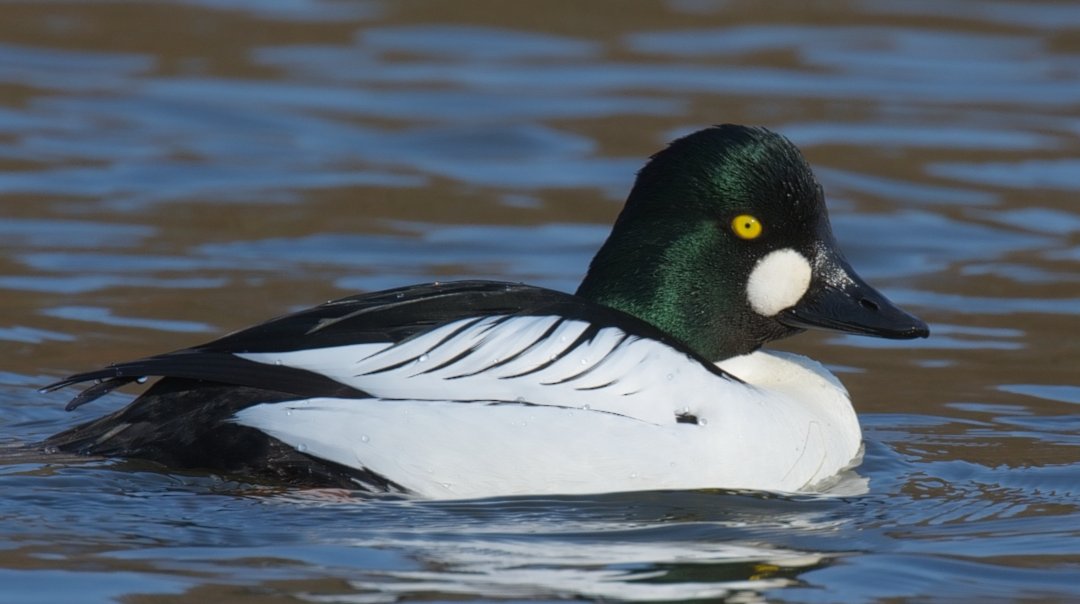
The Common Goldeneye is a compact diving duck of northern forests, named for its bright golden-yellow eyes and noted for its triangular head. Males are black and white with a glossy green head and a round white cheek spot; females have a chocolate-brown head and grey body. It breeds on lakes and rivers of the boreal forest across North America and Eurasia, nesting in tree cavities, and winters on temperate coasts and large ice-free inland waters.
Did you know?
- Its wings make a clear, ringing whistle in flight.
- It readily uses nest boxes and often returns to the same site year after year.
Voice
About the species
Identification
A smallish diving duck with a triangular, angular head and a short black bill; it often swims low in the water. The male is black and white with a green-glossed black head and a white spot at the base of the bill; the female has a chocolate-brown head, grey-brown body and often a pale neck ring. Both sexes show large white wing patches, conspicuous in flight, and the wings make a characteristic whistling sound. Barrow's Goldeneye male has a crescent-shaped, not round, face patch.
Family
Anatidae
Size
Large (crow)
Colours
white, black, green, yellow
About the habitat
Lakes, slow rivers and coastal bays with suitable tree cavities or nest boxes nearby; in winter protected coastal waters and large ice-free lakes.
Diet
Dives for aquatic insects and their larvae, crustaceans and molluscs; also small fish, fish eggs and some plant matter. Insects dominate in the nesting season, crustaceans and molluscs in winter.
Behaviour
A true diving duck that makes frequent, short dives and often swims with the neck held low. In spring the males perform dramatic head-throw displays with nasal calls; otherwise it is mostly quiet, though its wings make a ringing whistle in flight. It nests in natural tree holes, old Black Woodpecker holes and nest boxes; the male leaves early in incubation. The ducklings jump from the cavity soon after hatching and follow the female to water, and broods often mix. Females frequently lay eggs in other goldeneyes' nests.
Sources
Photo: Patko erika, CC BY 2.0
Sound: Pascal Christe, CC BY-SA 4.0 https://commons.wikimedia.org/wiki/File:Bucephala_clangula_-_Common_Goldeneye_XC518957.mp3
Sound: Alvaro Ortiz Troncoso, CC BY-SA 4.0 https://commons.wikimedia.org/wiki/File:Sonus_naturalis_-_Soundscape_XC416434.mp3
Text: Wikipedia (English) + FinBIF species descriptions + Wikipedia (Finnish), CC BY-SA 4.0; FinBIF: CC BY 4.0; Wikipedia: CC BY-SA 4.0 https://en.wikipedia.org/wiki/Common_goldeneye