Suomi
 Svenska
 Polski
 Čeština
 Slovenčina
 Norsk
 Dansk
Brant
Branta bernicla
Identify the Brant by sound or photo and log your sightings with Birdpass.


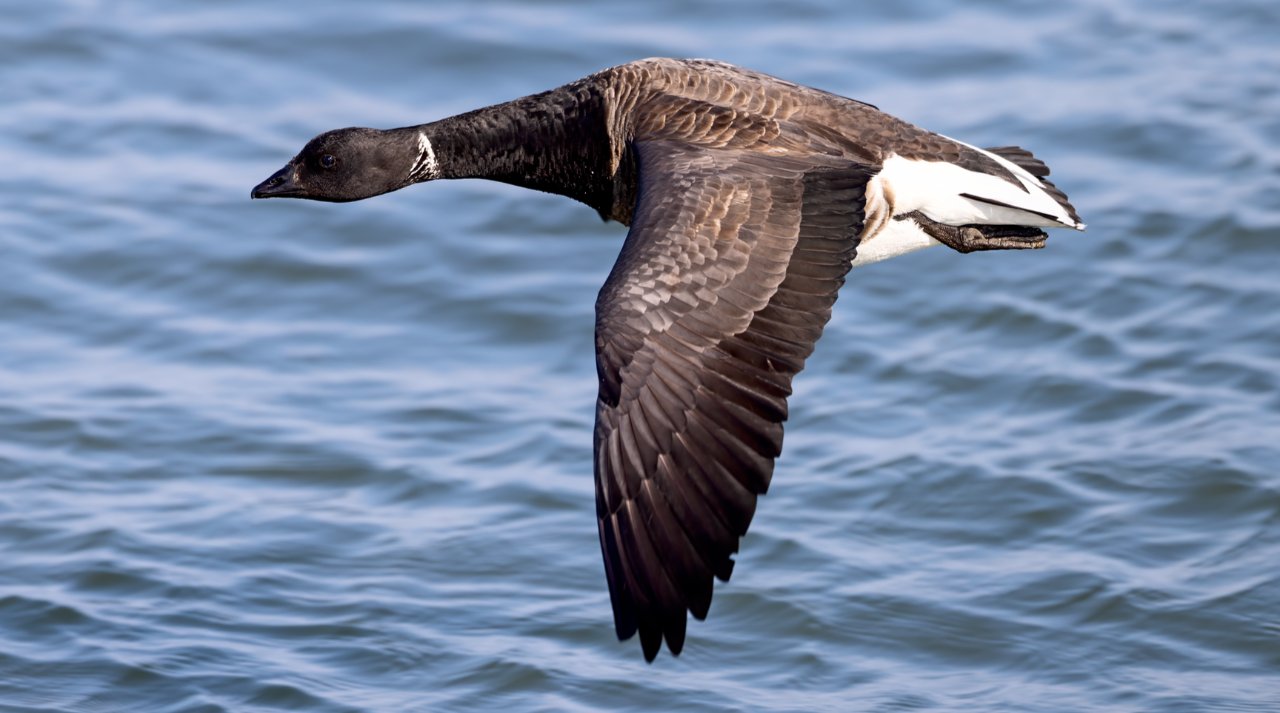
The Brant Goose is a small, dark sea goose with three main forms – dark-bellied, pale-bellied and black – that breed on the high Arctic tundra and winter on temperate coasts and estuaries. It is closely tied to salty shorelines rich in marine plants and migrates in cohesive, low-flying flocks.
Did you know?
- Medieval Europeans believed Brant and Barnacle Geese grew from floating barnacles.
- The Brent oilfield in the North Sea was named after this goose.
Voice
About the species
Identification
A small, short-billed goose: head, neck and breast black with a white patch on the neck, the back grey-brown and the flanks paler, and the undertail pure white. Its small size, short bill and neck patch separate it from other geese; it lacks the white face of Barnacle Goose.
Family
Anatidae
Size
Very large (swan)
Colours
black, brown, white
About the habitat
Breeds on low, wet coastal tundra near deltas and lagoons. Outside the breeding season shallow coasts, bays, estuaries and tidal flats, and nearby coastal fields.
Diet
Mainly marine plants such as eelgrass and sea lettuce, as well as saltmarsh plants and green algae; on the breeding grounds tundra grasses, herbs and mosses. It increasingly grazes coastal fields in winter.
Behaviour
Highly migratory and gregarious; flocks often fly in low, undulating lines over the sea with soft, rolling calls. Feeds by grazing and dabbling on intertidal flats at low tide. Pairs usually mate for life and migrate as family groups. Nests on the ground near water; the chicks walk, swim and feed within a day of hatching.
Sources
Photo: Needsmoreritalin, CC BY-SA 4.0 https://commons.wikimedia.org/wiki/File:Atlantic Brant Fly-By Wiki.png
Sound: Sonothèque ADVL, XC815463, CC0 1.0 https://xeno-canto.org/815463
Sound: Sonothèque ADVL, XC705887, CC0 1.0 https://xeno-canto.org/705887
Text: Wikipedia (English) + FinBIF species descriptions, CC BY-SA 4.0; FinBIF: CC BY 4.0 https://en.wikipedia.org/wiki/Brant_(goose)