
 Suomi
 Svenska
 Polski
 Čeština
 Slovenčina
 Norsk
 Dansk
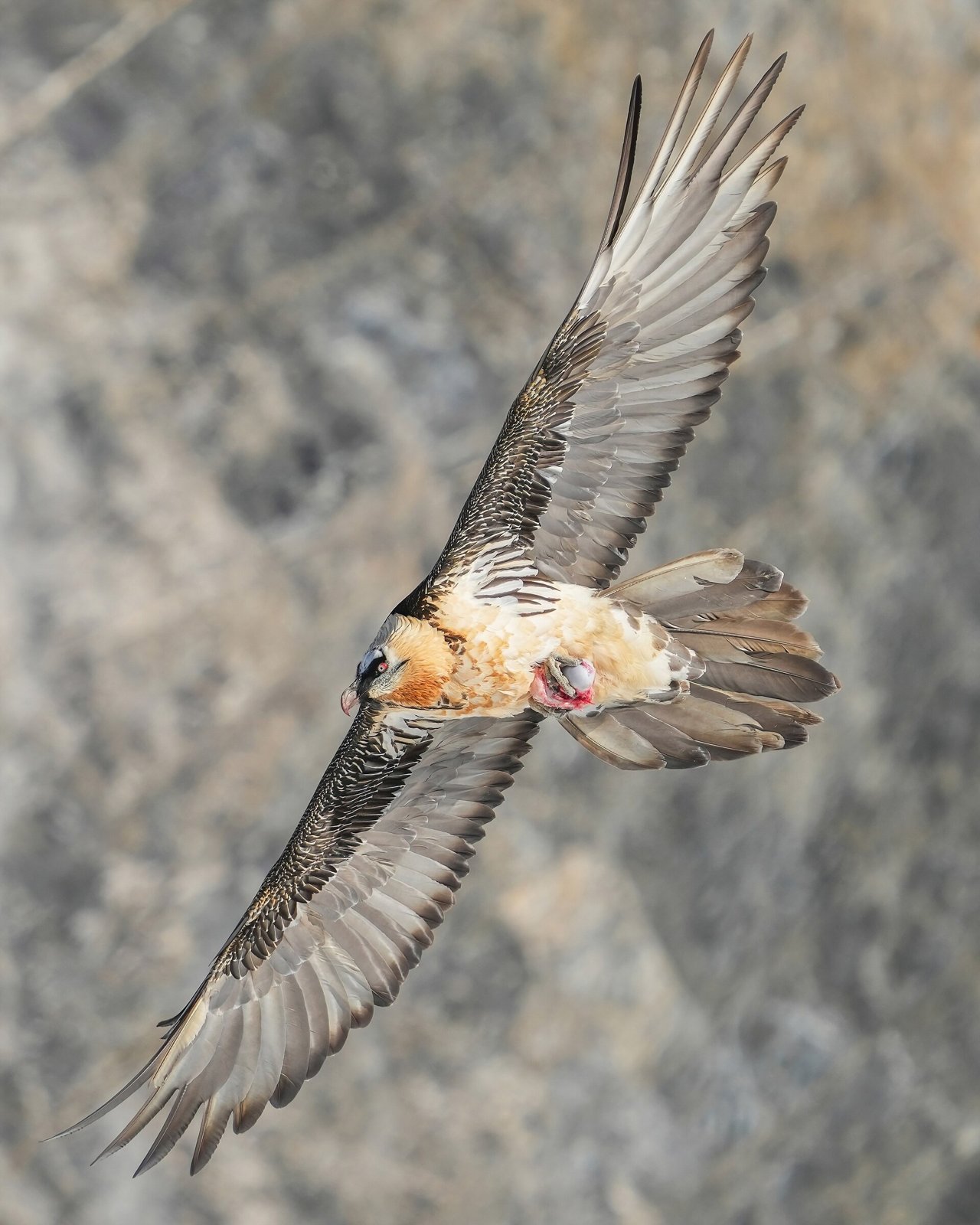
Bearded Vulture
Gypaetus barbatus
Identify the Bearded Vulture by sound or photo and log your sightings with Birdpass.


The Bearded Vulture is a massive, long-winged, wedge-tailed bird of prey of high mountains in southern Europe, Africa and Asia. Unique among vertebrates, it lives mostly on bone, which it digests with extremely acidic stomach juices. Although traditionally grouped with Old World vultures, it forms its own lineage with the Egyptian Vulture and has a feathered head and neck. It is declining and listed as Near Threatened.
Did you know?
- It is the only known vertebrate whose diet is 70–90% bone.
- Bearded Vultures stain their pale plumage orange by bathing in iron-rich mud.
About the species
Identification
A huge vulture with long, narrow, pointed wings and a long, wedge-shaped tail, giving a falcon-like silhouette. Adults are dark slate-grey above with orange or rusty-white head and underparts, a black mask and a black “beard” of bristles below the bill; the eye has a red ring. Young birds are dark brown all over.
Family
Accipitridae
Size
Very large (swan)
Colours
brown, orange, white, black, grey
About the habitat
Cliffs and crags in high mountains, from southern Europe, the Caucasus and Iran across the Himalayas and the Tibetan Plateau to China, and in African highlands such as the Atlas, the Ethiopian Highlands and the Drakensberg.
Diet
Mainly bones (70–90% of the diet) and marrow, digested with very strong stomach acid; it also eats dried skeletal remains of long-dead carcasses.
Behaviour
Soars along cliffs and ridges, carrying large bones aloft and dropping them onto rocks to break them open. Mostly silent except for sharp whistles in display. It nests on mountain ledges and lays one or two eggs in midwinter, which hatch in early spring.
Sources
Photo: Giles Laurent, CC BY-SA 4.0 https://commons.wikimedia.org/wiki/File:010e Wild Bearded Vulture in flight at Pfyn-Finges (Switzerland) Photo by Giles Laurent.jpg
Text: Wikipedia (English), CC BY-SA 4.0 https://en.wikipedia.org/wiki/Bearded_vulture
 Photo by Giles Laurent.jpg)