
 Suomi
 Svenska
 Polski
 Čeština
 Slovenčina
 Norsk
 Dansk
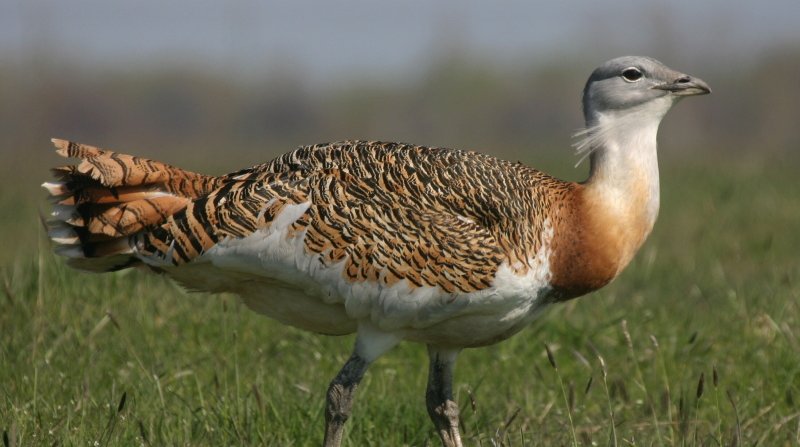
Great Bustard
Otis tarda
Identify the Great Bustard by sound or photo and log your sightings with Birdpass.


The Great Bustard is a massive, ground-dwelling bird of open grassland and farmland and the only member of its genus. It breeds from Morocco and Iberia across Europe to Central and East Asia; European birds are largely resident, while many Asian birds migrate south in winter. Males are among the heaviest flying birds and show long white whiskers in the breeding season, while females are much smaller. It is Endangered, with about 60% of the world population in Spain and Portugal, and has been reintroduced where it had died out.
Did you know?
- The heaviest verified flying bird on record was a Great Bustard of about 21 kg.
- It is the most size-dimorphic living bird: males can weigh more than twice as much as females.
Voice
About the species
Identification
A very large, heavy bird: males up to about a metre long with a wingspan of about 240 cm and a weight of up to 16 kg; females are a third smaller and much lighter. The back is barred brown and the underparts clearly white; the neck is long and grey, and the breast and neck sides of males are rufous. In flight the wings show large white areas. Its huge size, long neck and contrast between brown back and white belly set it apart.
Family
Otididae
Size
Very large (swan)
Colours
brown, white, grey, black
About the habitat
Open, flat to gently rolling grassland and steppe and extensive, lightly disturbed farmland with cereals and fodder crops, with long sightlines and little human activity.
Diet
Omnivorous: green shoots, leaves, seeds and crops, supplemented by insects such as beetles and grasshoppers and occasionally small vertebrates; the diet varies with season.
Behaviour
Wary, it spends most of its time walking and foraging in open country and avoids human disturbance, especially when breeding. In spring males gather at leks and perform a spectacular “foam-bath” display, turning their plumage inside out into a white ball. The female nests in a scrape on the ground and raises the chicks alone.
Sources
Photo: Andrej Chudý from Slovakia, CC BY-SA 2.0 https://commons.wikimedia.org/wiki/File:Drop fúzatý (Otis tarda) (2416576086).jpg
Sound: Bezdzwiek, CC BY-SA 4.0 https://commons.wikimedia.org/wiki/File:Głos_dropa.ogg
Text: Wikipedia (English), CC BY-SA 4.0 https://en.wikipedia.org/wiki/Great_bustard
 (2416576086).jpg)