
 Suomi
 Svenska
 Polski
 Čeština
 Slovenčina
 Norsk
 Dansk
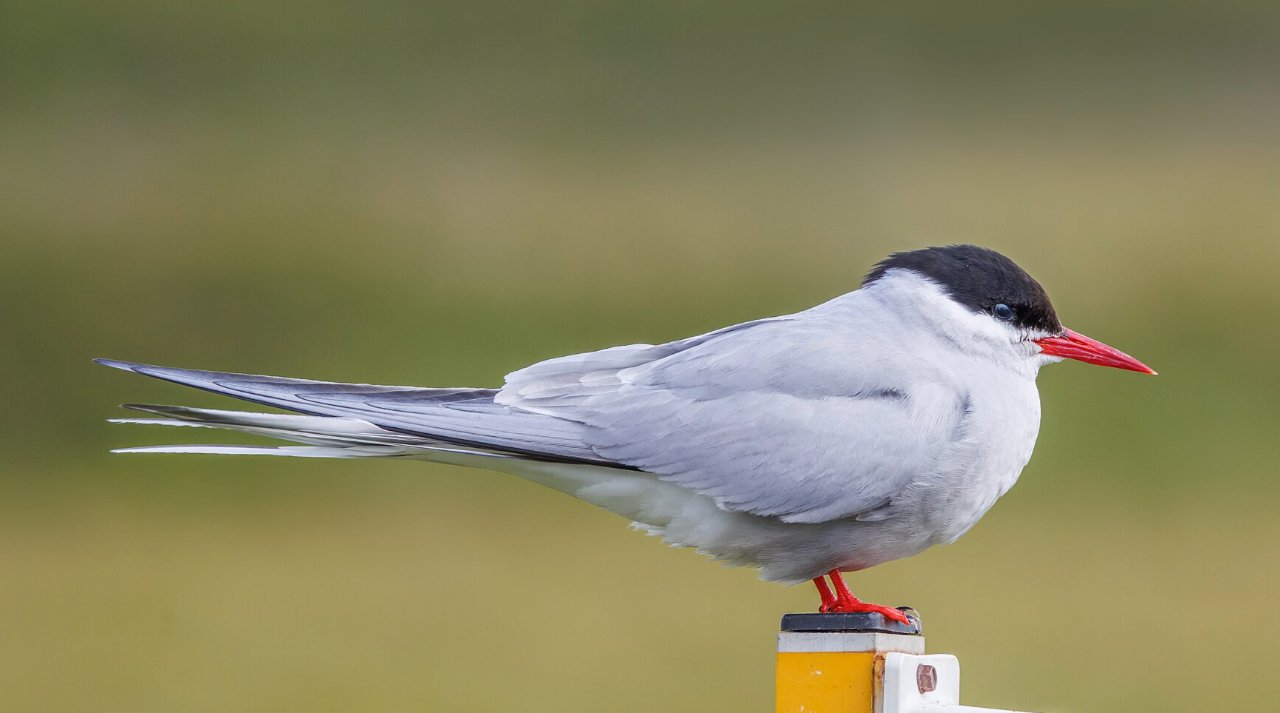
Arctic Tern
Sterna paradisaea
Identify the Arctic Tern by sound or photo and log your sightings with Birdpass.


The Arctic Tern is a graceful grey-and-white tern that breeds around Arctic and subarctic coasts, lakes and tundra and spends the northern winter in the Southern Ocean near Antarctica. Its pole-to-pole migrations are the longest of any animal, giving it two summers a year. In breeding plumage it has a black cap and a blood-red bill and legs. It is long-lived and still abundant.
Did you know?
- A tagged Arctic Tern flew about 96,000 km in ten months.
- It sees more daylight in a year than any other animal.
Voice
About the species
Identification
A slender tern with a dark red bill usually without a black tip, short legs and a rounded head. At rest the long tail projects clearly beyond the wingtips (a difference from Common Tern). In flight the outer wing has only a narrow dark trailing edge and all the flight feathers look translucent; its calls are higher and shriller than a Common Tern's.
Family
Sternidae
Size
Medium (thrush)
Colours
grey, white, black, red
About the habitat
Breeds on treeless rocky or shingle islets, sandy spits and tundra shores, as well as on northern lakes and rivers, often with other terns and gulls; outside the breeding season at sea, reaching the Antarctic pack ice.
Diet
Mainly small fish and marine crustaceans taken by hovering and plunge-diving or dipping; inland it feeds largely on insects.
Behaviour
An exceptionally strong flier that follows wind-aided, meandering routes on migration and spends most of the year far offshore. It breeds in colonies or scattered pairs and is a fearless nest defender, striking intruders on the head. In colonies it is noisy, with sharp alarm calls.
Sources
Photo: Charles J. Sharp, CC BY-SA 4.0 https://commons.wikimedia.org/wiki/File:Arctic tern (Sterna paradisaea) Flatey 3.jpg
Sound: Doug Hynes, XC564600, CC BY-SA 4.0 https://xeno-canto.org/564600
Text: Wikipedia (English) + FinBIF species descriptions + Wikipedia (Finnish), CC BY-SA 4.0; FinBIF: CC BY 4.0; Wikipedia: CC BY-SA 4.0 https://en.wikipedia.org/wiki/Arctic_tern
 Flatey 3.jpg)