Suomi
 Svenska
 Polski
 Čeština
 Slovenčina
 Norsk
 Dansk
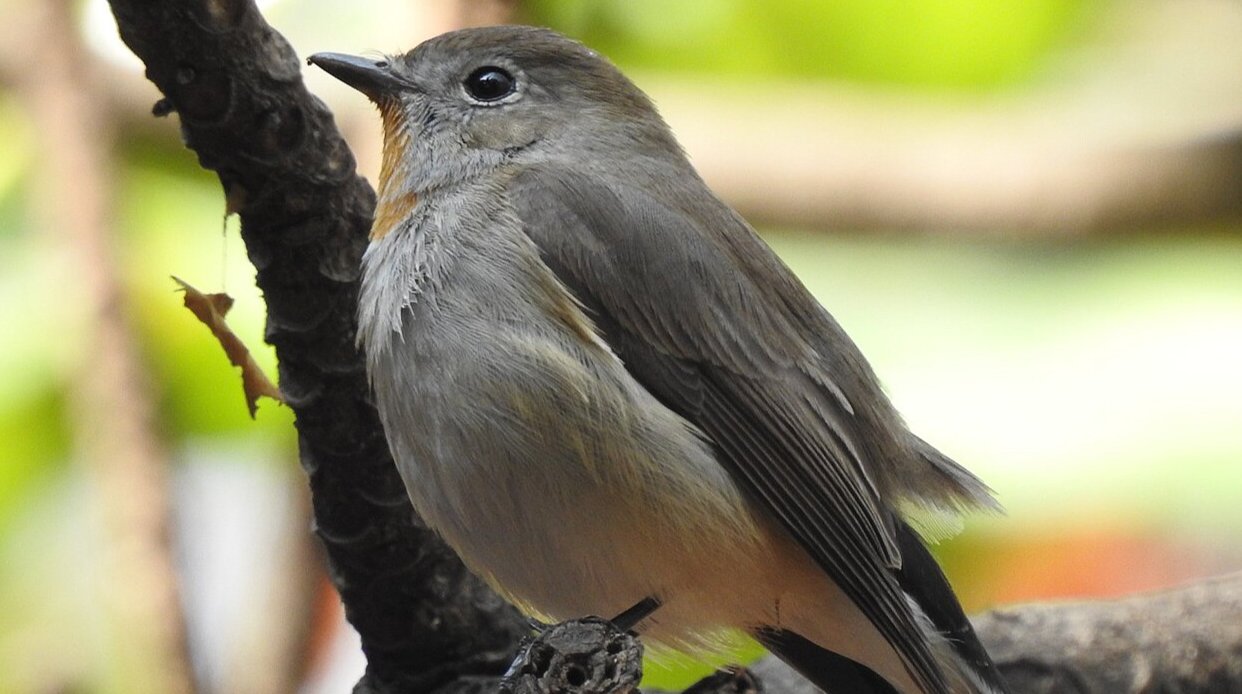
Taiga Flycatcher
Ficedula albicilla
Identify the Taiga Flycatcher by sound or photo and log your sightings with Birdpass.


The Taiga Flycatcher is a small flycatcher that breeds in the taiga of northern Eurasia from eastern Russia through Siberia to Mongolia and winters in South and Southeast Asia. Breeding males have an orange-red throat, while females are plain brown. It was formerly treated as a subspecies of the Red-breasted Flycatcher, which it closely resembles, and it is an occasional vagrant to western Europe.
Did you know?
- Its species name albicilla means roughly “white tail”, after the white bases of its outer tail feathers.
- The genus name Ficedula comes from the Latin for a small fig-eating bird.
About the species
Identification
Length 11–12.5 cm. Compared with Red-breasted Flycatcher, the male's orange-red throat patch is sharply bordered against the grey breast and the crown is brown; the female's throat is paler and contrasts with a darker breast. The black tail has white sides at the base. Its commonest call is a fast, hard rattle, and the song contains fast dry trills with rising and falling sections, which helps to separate it from Red-breasted Flycatcher.
Family
Muscicapidae
Size
Tiny (goldcrest)
Colours
grey, brown, white, orange
About the habitat
Breeds in taiga forest, especially deciduous-rich mixed woods; on migration and in winter wooded edges, parks and gardens.
Diet
Mainly small flying insects such as flies and midges, as well as beetles and other small invertebrates; occasionally small berries late in the season.
Behaviour
A typical flycatcher that watches from a low perch and darts out to seize passing insects, also gleaning from leaves and twigs; it often flicks its tail and wings. Outside the breeding grounds it is more often heard giving a sharp, dry rattle than singing.
Sources
Photo: Arunshank, CC BY-SA 4.0 https://commons.wikimedia.org/wiki/File:Taiga Flycatcher.jpg
Text: Wikipedia (English) + GBIF regional observations + Wikipedia (Finnish), CC BY-SA 4.0; GBIF occurrence data; Wikipedia: CC BY-SA 4.0 https://en.wikipedia.org/wiki/Taiga_flycatcher