Suomi
 Svenska
 Polski
 Čeština
 Slovenčina
 Norsk
 Dansk
Sociable Lapwing
Vanellus gregarius
Identify the Sociable Lapwing by sound or photo and log your sightings with Birdpass.


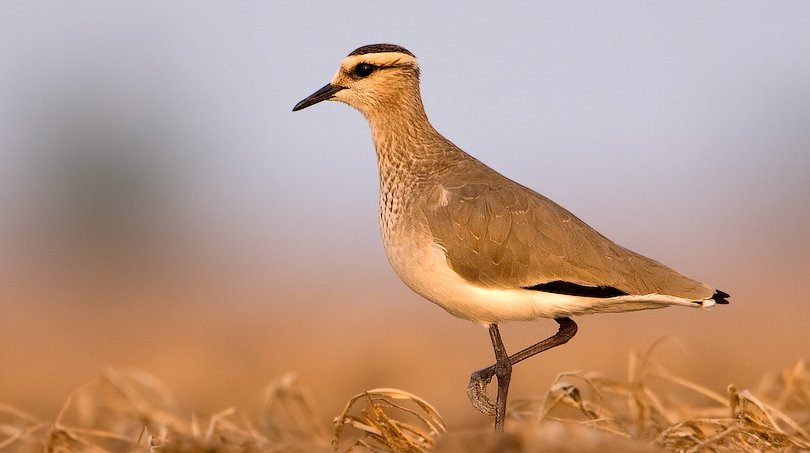
The Sociable Lapwing is a medium-sized, long-legged lapwing of the dry steppes, breeding mainly in Kazakhstan and wintering from the Middle East and Pakistan to India and north-east Africa. It has a bold head pattern with a black cap and white supercilium, and in summer a black and chestnut belly. It has declined drastically and is Critically Endangered, with hunting on migration among the threats.
Did you know?
- Its name gregarius means “sociable”.
- Its world population is estimated at only a few thousand birds.
Voice
About the species
Identification
A medium-sized wader (about 27–30 cm), sandy brown overall. In breeding plumage the crown is black, bordered by a white supercilium with a black eye stripe below; the belly has a black and chestnut patch. The legs are long and black and the bill short and black. In flight white secondaries show next to black primaries, and the white tail has a black band. It lacks the crest of Northern Lapwing.
Family
Charadriidae
Size
Medium (thrush)
Colours
brown, white, black, grey
About the habitat
Open steppe, dry grassland, salt deserts and dried floodplains; outside the breeding season fields, fallows and semi-arid plains.
Diet
Mainly ground insects such as beetles and grasshoppers, picked from short grassland and fields; also some plant material.
Behaviour
A sociable, ground-feeding lapwing that often flocks with other lapwings on migration and in winter. It nests in loose colonies in simple ground scrapes on the steppe, usually laying four eggs; incubation lasts about 25 days and the chicks fledge at 35–40 days. It gives a harsh, rasping call.
Sources
Photo: Cks3976, CC BY-SA 3.0 https://commons.wikimedia.org/wiki/File:SociablePlover.jpg
Sound: Marie-Lan Taÿ Pamart, XC467005, CC BY-SA 4.0 https://xeno-canto.org/467005
Text: Wikipedia (English) + GBIF regional observations + Wikipedia (Finnish), CC BY-SA 4.0; GBIF occurrence data; Wikipedia: CC BY-SA 4.0 https://en.wikipedia.org/wiki/Sociable_lapwing