Suomi
 Svenska
 Polski
 Čeština
 Slovenčina
 Norsk
 Dansk
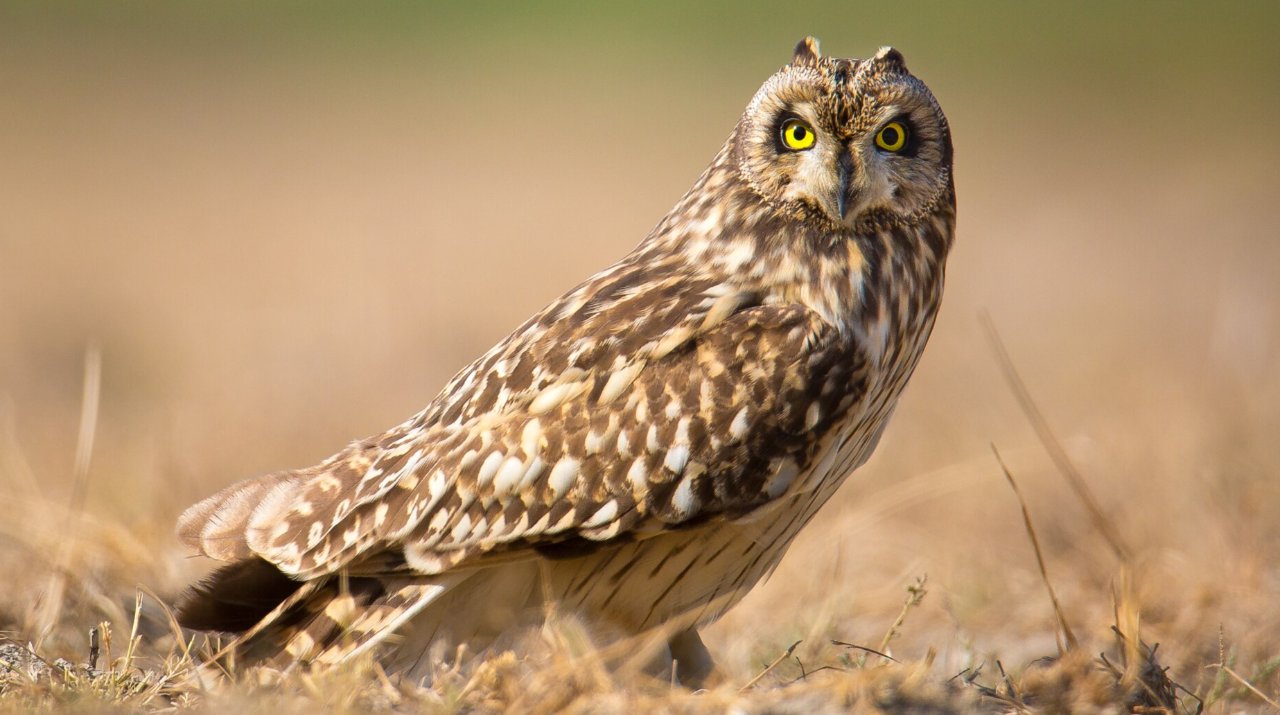
Short-eared Owl
Asio flammeus
Identify the Short-eared Owl by sound or photo and log your sightings with Birdpass.


The Short-eared Owl is a widespread owl of open country – grassland, bog, meadow and tundra – found on every continent except Antarctica and Australia. Named for its tiny ear tufts, it hunts low over open ground with a buoyant, moth-like flight and is often active by day. It is partly migratory and highly nomadic, following vole booms.
Did you know?
- It is one of the few owls that routinely hunt in daylight.
- When nesting on the ground it may lure predators away by pretending to have a broken wing.
Voice
About the species
Identification
A pale owl of open country with yellow eyes accentuated by black eye patches. It resembles Long-eared Owl but is paler; the underwing has narrow dark tips and a clear white trailing edge. The breast is streaked, but the belly is fairly plain; the underwings are clearly paler than the upperwings.
Family
Strigidae
Size
Large (crow)
Colours
brown, orange, black, white
About the habitat
Open habitats such as bogs and mires, coastal meadows, grassland, heath, hayfields and farmland; also tundra and dunes.
Diet
Mainly voles and other small mammals; also small birds, particularly near coasts, and large insects.
Behaviour
Often hunts in daylight, coursing low over open ground with irregular, flexible wingbeats. In the breeding season the male performs display flights with wing-clapping. It nests on the ground in a simple scrape hidden in low vegetation; clutches are larger in good vole years. The female incubates for about four weeks; the chicks leave the nest at about two weeks and fly at four weeks. Adults may feign injury to lure predators away.
Sources
Photo: Sumeet Moghe, CC BY-SA 4.0 https://commons.wikimedia.org/wiki/File:Short Eared Owl on the Ground.jpg
Sound: Sonothèque ADVL, XC1080062, CC0 1.0 https://xeno-canto.org/1080062
Text: Wikipedia (English) + FinBIF species descriptions + Wikipedia (Finnish), CC BY-SA 4.0; FinBIF: CC BY 4.0; Wikipedia: CC BY-SA 4.0 https://en.wikipedia.org/wiki/Short-eared_owl