
 Suomi
 Svenska
 Polski
 Čeština
 Slovenčina
 Norsk
 Dansk
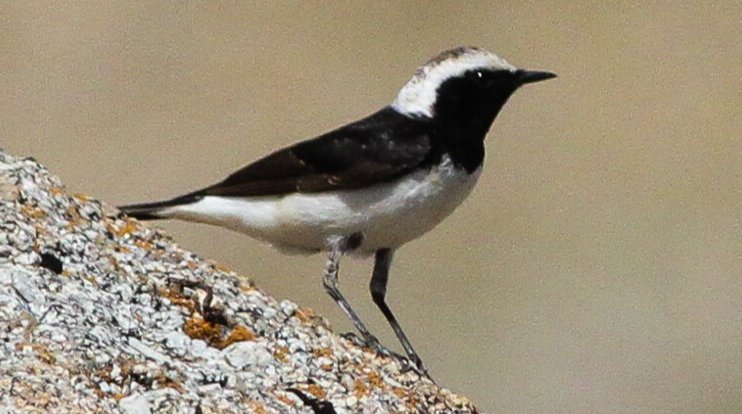
Pied Wheatear
Oenanthe pleschanka
Identify the Pied Wheatear by sound or photo and log your sightings with Birdpass.


The Pied Wheatear is a small wheatear of rocky, open country that breeds from south-eastern Europe across Central Asia to China and winters mainly in East Africa and southern Arabia. The breeding male is strikingly black and white, with a pale crown and nape and a black back, face and throat; the female is browner. It nests in holes in stony country.
Did you know?
- It was described by Ivan Lepechin in 1770.
- The Cyprus Wheatear was formerly treated as its subspecies.
Voice
About the species
Identification
The size of a Northern Wheatear (about 14–16.5 cm). The breeding male is easy to recognise: the back, wings, face and throat are black, while the nape, crown and underparts are white; the tail shows the typical wheatear black-and-white pattern. Females and young are grey-brown above and pale below and can be hard to separate from other wheatears.
Family
Turdidae
Size
Small (sparrow)
Colours
black, white, brown
About the habitat
Stony slopes, hilly steppe with sparse vegetation and rocky uplands; in winter rocky areas and plains with thorny scrub.
Diet
Mainly small invertebrates – ants, grasshoppers, beetles, flies, moths, larvae and spiders – and some seeds.
Behaviour
Usually seen singly or in pairs on rocky, open ground, perching on stones or bushes, alert and tail-bobbing, and making short sallies to catch prey. The male sings a varied, often imitative song from a perch or in a short song flight. It nests in a hole, under a stone or in a crevice, laying four to six eggs.
Sources
Photo: Ron Knight from Seaford, East Sussex, United Kingdom, CC BY 2.0 https://commons.wikimedia.org/wiki/File:Pied Wheatear (Oenanthe pleschanka) (8079431820).jpg
Sound: Jochem Verweij, XC929263, CC BY-SA 4.0 https://xeno-canto.org/929263
Text: Wikipedia (English) + FinBIF species descriptions + Wikipedia (Finnish), CC BY-SA 4.0; FinBIF: CC BY 4.0; Wikipedia: CC BY-SA 4.0 https://en.wikipedia.org/wiki/Pied_wheatear
 (8079431820).jpg)