
 Suomi
 Svenska
 Polski
 Čeština
 Slovenčina
 Norsk
 Dansk
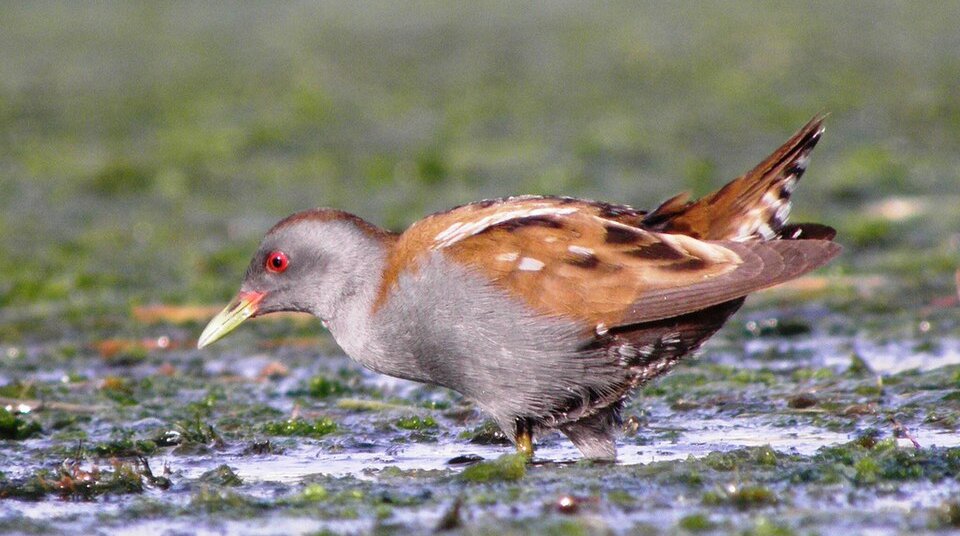
Little Crake
Zapornia parva
Identify the Little Crake by sound or photo and log your sightings with Birdpass.


The Little Crake is a tiny rail of dense reedbeds that breeds in eastern and central Europe into western Asia and winters in Africa. Unusually for crakes, the sexes differ: males are blue-grey below, females buffy. It has a short yellow-green bill with a red base and lacks the flank barring and spotting of the Spotted Crake. It is secretive and usually detected by its accelerating, yapping song at night.
Did you know?
- Its name parva is Latin for “small”.
- Unlike most of its relatives, the sexes look clearly different.
Voice
About the species
Identification
A very small crake: the male has dove-grey underparts and a brown back with few white spots; the female has pale buffy underparts. Young birds have a brown, white-spotted back, barred belly and pale breast. The undertail is barred black and white, the legs green, and the short bill has a small red spot at the base. Its small size, green legs, red bill base and the male's grey underparts separate it from other small crakes.
Family
Rallidae
Size
Small (sparrow)
Colours
grey, brown, white, red
About the habitat
Dense reedbeds and other tall wetland vegetation with open water and floating plants, such as lake margins and fishponds.
Diet
Mainly insects and other small aquatic animals, picked from the surface or probed from mud and shallow water, often while walking on floating vegetation.
Behaviour
Shy and skulking in the breeding season, usually heard rather than seen, especially at night, when the male gives a series of yapping “kwek” notes that accelerate and descend. It clambers on floating leaves and reed stems. It nests in dry spots within reedbeds, laying 4–7 eggs. It is easier to see on migration.
Sources
Photo: ΝΙΚΟΣ ΣΑΜΑΡΙΤΑΚΗΣ from CHANIA, GREECE, CC BY 2.0 https://commons.wikimedia.org/wiki/File:Porzana parva (50).jpg
Sound: Jens Loose, XC648398, CC BY-SA 4.0 https://xeno-canto.org/648398
Text: Wikipedia (English), CC BY-SA 4.0 https://en.wikipedia.org/wiki/Little_crake
.jpg)