
 Suomi
 Svenska
 Polski
 Čeština
 Slovenčina
 Norsk
 Dansk
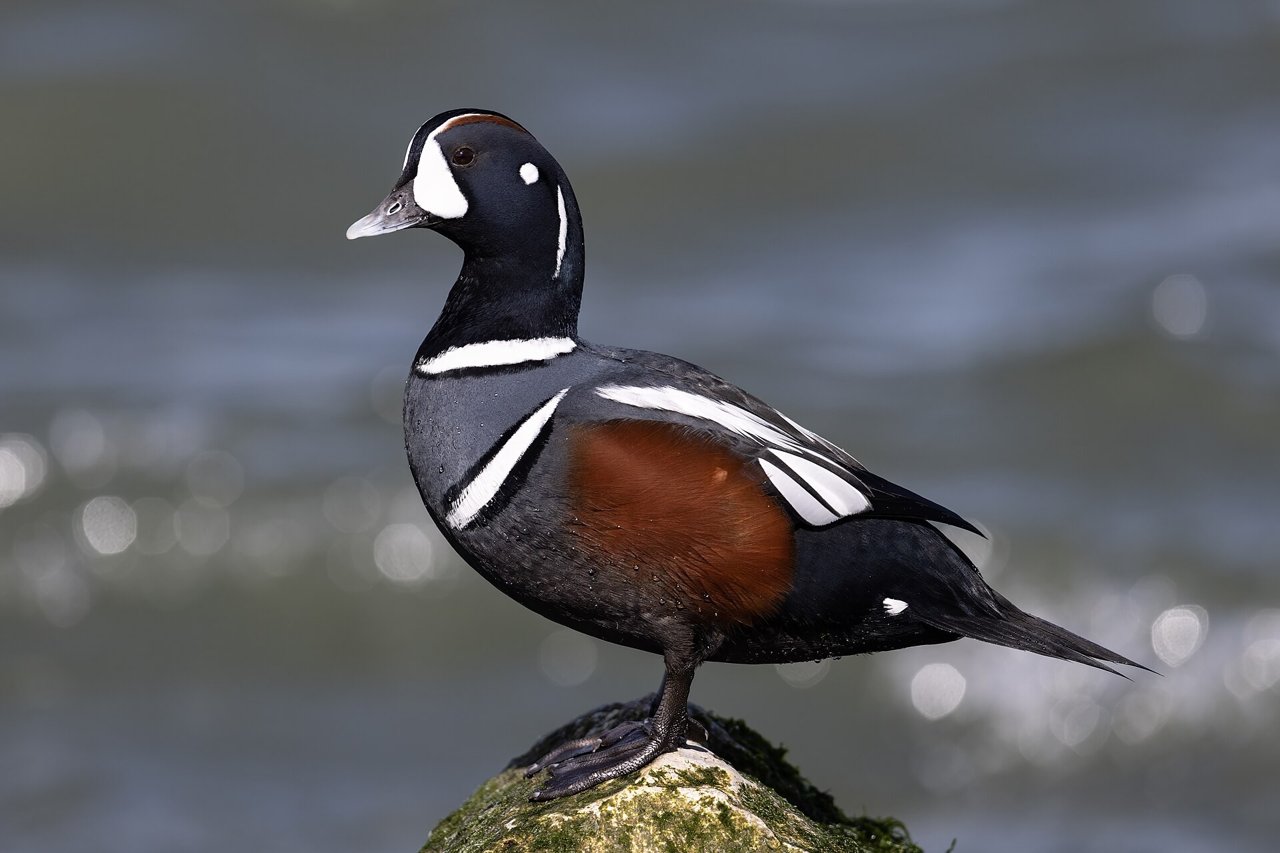
Harlequin Duck
Histrionicus histrionicus
Identify the Harlequin Duck by sound or photo and log your sightings with Birdpass.


The Harlequin Duck is a small sea duck best known for the male's bold slate-blue, chestnut and white pattern, while females are brownish-grey with white face spots. Its name refers to the colourful Harlequin of Italian theatre. It breeds along cold, fast-flowing streams in northern North America, Greenland, Iceland and eastern Russia and winters on wave-battered rocky coasts, usually moving only short distances.
Did you know?
- Its dense plumage traps so much air that it pops up like a cork after a dive.
- Both its common and scientific names refer to the theatrical Harlequin – histrio is Latin for “actor”.
About the species
Identification
The male is dark slate-blue with white and chestnut markings; the female is brownish-grey with a white spot in front of and behind the eye. Length 38–51 cm, weight 500–800 g, wingspan about 65 cm. Its showy pattern and dark overall look separate it from other ducks, especially when seen in rapids or surf.
Family
Anatidae
Size
Large (crow)
Colours
blue, brown, white, black
About the habitat
Breeds beside cold, fast-flowing rivers and streams; winters on rocky coasts with pounding surf. A rare vagrant elsewhere in Europe.
Diet
Mainly aquatic insects and their larvae in summer, and molluscs and crustaceans on the coast in winter, taken by diving; it also dabbles at the surface.
Behaviour
A whitewater specialist that dives and swims in rapids and coastal surf, often in small groups. Pairs form in winter and may last several years; males leave soon after incubation starts and give no parental care. It nests on the ground, well hidden near the stream.
Sources
Photo: Chuck Homler d/b/a Focus On Wildlife, CC BY-SA 4.0 https://commons.wikimedia.org/wiki/File:Drake Harlequin duck (Histrionicus histrionicus) perched on a rock in the Barnegat Inlet, New Jersey, USA (cropped).jpg
Text: Wikipedia (English), CC BY-SA 4.0 https://en.wikipedia.org/wiki/Harlequin_duck
 perched on a rock in the Barnegat Inlet, New Jersey, USA (cropped).jpg)