
 Suomi
 Svenska
 Polski
 Čeština
 Slovenčina
 Norsk
 Dansk
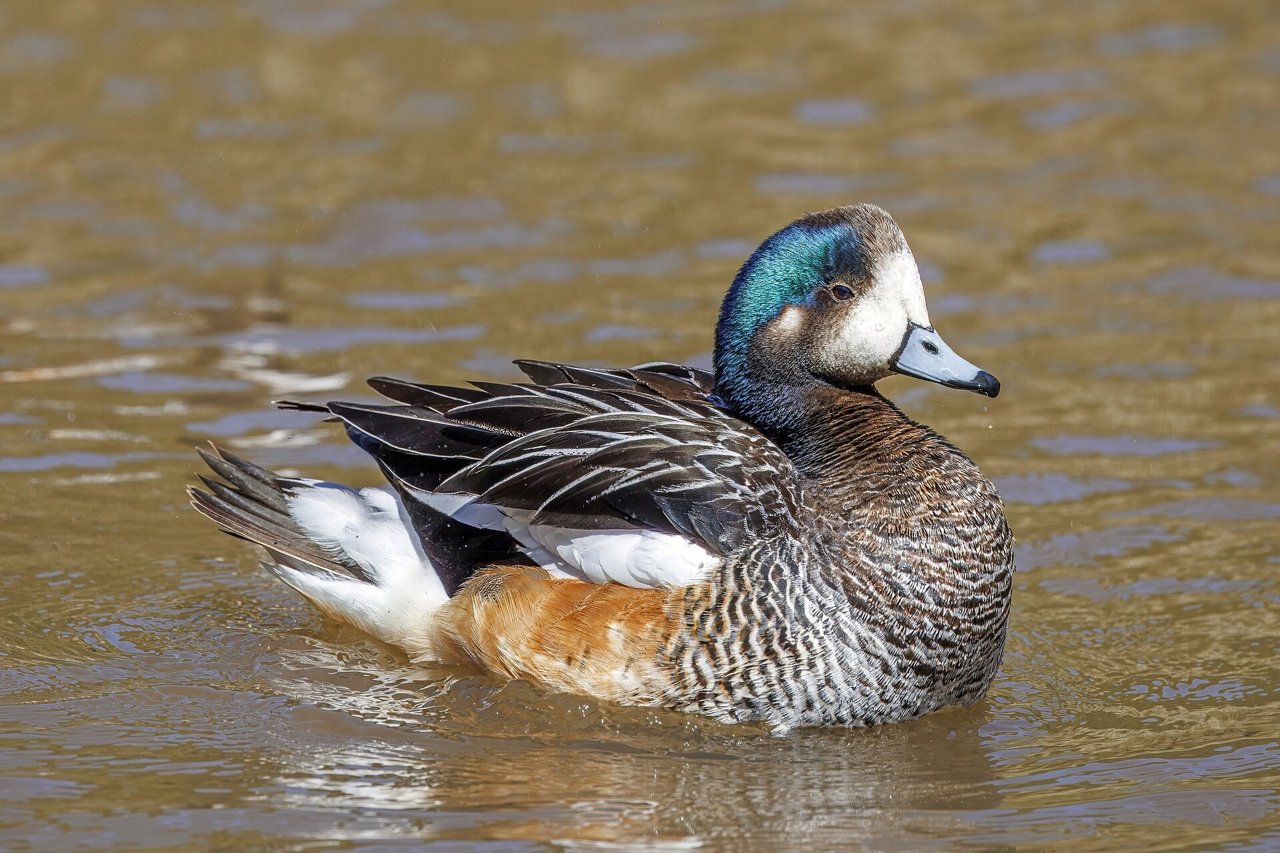
Chiloe Wigeon
Mareca sibilatrix
Identify the Chiloe Wigeon by sound or photo and log your sightings with Birdpass.


The Chiloe Wigeon is a boldly marked dabbling duck of southern South America, named after the Chiloé Archipelago. It has a glossy green-blue head, white face, black-and-white barred breast and rusty flanks. It breeds mainly in Argentina, Uruguay and Chile and moves north to southern Brazil in winter. It is popular in waterfowl collections, and escapes sometimes turn up in Europe.
Did you know?
- Its scientific name, sibilatrix, means “whistler”.
- Unlike most ducks, the male helps rear the ducklings.
About the species
Identification
A wigeon with a white face and forehead, a dark glossy green-blue head and nape, a finely barred black-and-white breast, rusty-orange flanks and a black-and-white patterned back. The bill is small and blue-grey with a black tip. The sexes are similar, the female slightly duller.
Family
Anatidae
Size
Large (crow)
Colours
black, white, brown, green, grey
About the habitat
Calm fresh waters – lakes, marshes, shallow lagoons and slow rivers – across southern South America, including the Falkland Islands.
Diet
Mainly aquatic plants and grasses, sometimes coastal algae.
Behaviour
A monogamous dabbling duck that breeds in the southern spring (September–December). Pairs hold small territories and nest in grass or under bushes; the female lays 8–10 eggs that hatch after about 24–25 days. Unusually, the male helps raise the brood. Both sexes give whistling calls.
Sources
Photo: Charles J. Sharp, CC BY-SA 4.0 https://commons.wikimedia.org/wiki/File:Chiloe wigeon (Mareca sibilatrix) male Tricao 3.jpg
Text: Wikipedia (English), CC BY-SA 4.0 https://en.wikipedia.org/wiki/Chilo%C3%A9_wigeon
 male Tricao 3.jpg)